
Textbook Question
Explain why or why not
Determine whether the following statements are true and give an explanation or counterexample.
b.If a sequence of positive numbers converges, then the sequence is decreasing.
60
views

 Verified step by step guidance
 06:00
06:00
 06:45 06:00
Explain why or why not
Determine whether the following statements are true and give an explanation or counterexample.
b.If a sequence of positive numbers converges, then the sequence is decreasing.
41–44. {Use of Tech} Remainders and estimates Consider the following convergent series.
a. Find an upper bound for the remainder in terms of n.
43. ∑ (k = 1 to ∞) 1 / 3ᵏ
67–70. Formulas for sequences of partial sums Consider the following infinite series.
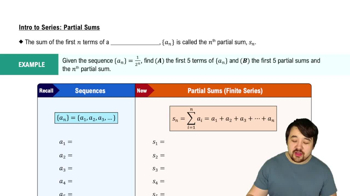
a.Find the first four partial sums S₁, S₂, S₃, S₄ of the series.
∑⁽∞⁾ₖ₌₁2⁄[(2k − 1)(2k + 1)]
72–75. {Use of Tech} Practical sequences
Consider the following situations that generate a sequence
b.Find an explicit formula for the terms of the sequence.
Drug elimination
Jack took a 200-mg dose of a pain killer at midnight. Every hour, 5% of the drug is washed out of his bloodstream. Let dₙ be the amount of drug in Jack’s blood n hours after the drug was taken, where d₀ = 200mg.
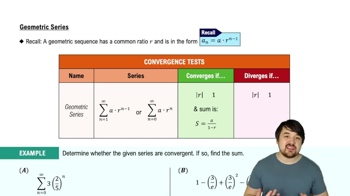
Find the first term a and the ratio r of each geometric series.
a. ∑ k = 0 to ∞(2/3) × (1/5)ᵏ
{Use of Tech} Periodic dosing
Many people take aspirin on a regular basis as a preventive measure for heart disease. Suppose a person takes 80 mg of aspirin every 24 hours. Assume aspirin has a half-life of 24 hours; that is, every 24 hours, half of the drug in the blood is eliminated.
a.Find a recurrence relation for the sequence {dₙ} that gives the amount of drug in the blood after the nᵗʰ dose, where d₁ = 80.