
Textbook Question
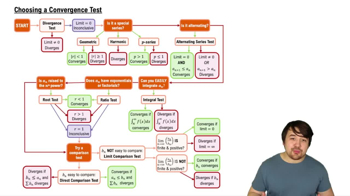
11–86. Applying convergence tests Determine whether the following series converge. Justify your answers.
∑ (from k = 1 to ∞)k! / (kᵏ + 3)
49
views

 Verified step by step guidance
 07:51
07:51
 10:54
10:54 04:30
04:3011–86. Applying convergence tests Determine whether the following series converge. Justify your answers.
∑ (from k = 1 to ∞)k! / (kᵏ + 3)
21–26. Recurrence relations Write the first four terms of the sequence {aₙ} defined by the following recurrence relations.
aₙ₊₁ = 2aₙ; a₁ = 2
48–63. Choose your test Determine whether the following series converge or diverge using the properties and tests introduced in Sections 10.3 and 10.4.
∑ (k = 1 to ∞) 1 / ( (3k + 1)(3k + 4) )
8–32. {Use of Tech} Estimating errors in partial sums For each of the following convergent alternating series, evaluate the nth partial sum for the given value of n. Then use Theorem 10.18 to find an upper bound for the error |S − Sₙ| in using the nth partial sum Sₙ to estimate the value of the series S.
∑ (k = 1 to ∞) (−1)ᵏ / k⁴; n = 4
54–69. Telescoping series
For the following telescoping series, find a formula for the nth term of the sequence of partial sums {Sₙ}. Then evaluate limₙ→∞ Sₙ to obtain the value of the series or state that the series diverges.
63. ∑ (k = 1 to ∞) 1 / ((k + p)(k + p + 1)), where p is a positive integer
11–86. Applying convergence tests Determine whether the following series converge. Justify your answers.
∑ (from k = 3 to ∞) 5 / (2 + lnk)