
Ch. 10 - Sequences and Infinite Series
Briggs - Calculus: Early Transcendentals 3rd Edition
Briggs3rd EditionCalculus: Early TranscendentalsISBN: 9780136847243Not the one you use?Change textbook
Chapter 10, Problem 10.4.39b

39–40. {Use of Tech} Lower and upper bounds of a series
For each convergent series and given value of n, use Theorem 10.13 to complete the following.


b. Find an upper bound for the remainder Rₙ.


39. ∑ (k = 1 to ∞) 1 / k⁷ ; n = 2

Verified step by step guidance
1
Identify the series given: \( \sum_{k=1}^{\infty} \frac{1}{k^7} \). This is a p-series with \( p = 7 \), which converges because \( p > 1 \).
Recall Theorem 10.13 (the Integral Test remainder estimate), which states that for a decreasing, positive, continuous function \( f(k) \), the remainder \( R_n = S - S_n \) satisfies the inequality \( R_n \leq \int_{n}^{\infty} f(x) \, dx \).
Set \( f(x) = \frac{1}{x^7} \) and write the upper bound for the remainder as \( R_n \leq \int_{n}^{\infty} \frac{1}{x^7} \, dx \).
Evaluate the improper integral \( \int_{n}^{\infty} x^{-7} \, dx \) by finding the antiderivative of \( x^{-7} \), which is \( \frac{x^{-6}}{-6} \), and then compute the limit as the upper bound approaches infinity.
Substitute \( n = 2 \) into the evaluated integral to express the upper bound for the remainder \( R_2 \) explicitly in terms of \( n \).

Verified video answer for a similar problem:

This video solution was recommended by our tutors as helpful for the problem above.
Video duration:
3m
Was this helpful?

Key Concepts

Here are the essential concepts you must grasp in order to answer the question correctly.

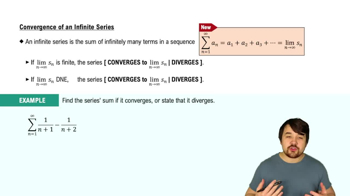
Convergent Series

A convergent series is an infinite sum whose partial sums approach a finite limit. For example, the series ∑ 1/k⁷ converges because the terms decrease rapidly and satisfy the p-series test with p = 7 > 1. Understanding convergence ensures that the remainder or error after n terms is well-defined.
Recommended video:
06:52
Convergence of an Infinite Series

Remainder (Error) in a Series Approximation

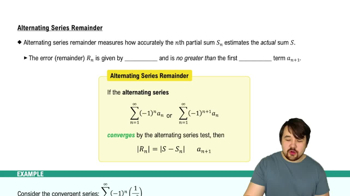
The remainder Rₙ is the difference between the infinite series sum and the partial sum up to n terms. It measures the error when approximating the series by a finite number of terms. Finding an upper bound for Rₙ helps estimate how close the partial sum is to the actual sum.
Recommended video:
06:32
Alternating Series Remainder

Theorem 10.13 (Integral Test Remainder Estimate)

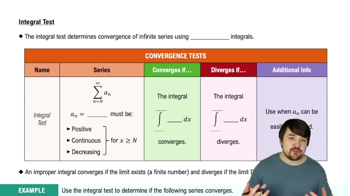
Theorem 10.13 provides bounds for the remainder of a convergent series whose terms come from a positive, decreasing function. It states that the remainder Rₙ is less than or equal to the integral of the function from n to infinity. This theorem allows calculation of explicit upper bounds for the error.
Recommended video:
07:25
Integral Test