
Ch. 10 - Sequences and Infinite Series
Briggs - Calculus: Early Transcendentals 3rd Edition
Briggs3rd EditionCalculus: Early TranscendentalsISBN: 9780136847243Not the one you use?Change textbook
Chapter 10, Problem 10.4.41b

41–44. {Use of Tech} Remainders and estimates Consider the following convergent series.


b. Find how many terms are needed to ensure that the remainder is less than 10⁻³.


41. ∑ (k = 1 to ∞) 1 / k⁶

Verified step by step guidance
1
Recognize that the series given is \( \sum_{k=1}^{\infty} \frac{1}{k^6} \), which is a convergent p-series with \( p = 6 > 1 \).
To estimate the remainder \( R_n = \sum_{k=n+1}^{\infty} \frac{1}{k^6} \), use the integral test remainder estimate, which states that \( R_n \leq \int_n^{\infty} \frac{1}{x^6} \, dx \).
Set up the integral \( \int_n^{\infty} x^{-6} \, dx \) and evaluate it: \( \int_n^{\infty} x^{-6} \, dx = \lim_{t \to \infty} \int_n^t x^{-6} \, dx \).
Calculate the definite integral: \( \int_n^t x^{-6} \, dx = \left[ \frac{x^{-5}}{-5} \right]_n^t = \frac{1}{5 n^5} - \lim_{t \to \infty} \frac{1}{5 t^5} \). Since \( \lim_{t \to \infty} \frac{1}{t^5} = 0 \), the integral equals \( \frac{1}{5 n^5} \).
Set the remainder estimate less than \( 10^{-3} \): \( \frac{1}{5 n^5} < 10^{-3} \). Solve this inequality for \( n \) to find the minimum number of terms needed.

Verified video answer for a similar problem:

This video solution was recommended by our tutors as helpful for the problem above.
Video duration:
3m
Was this helpful?

Key Concepts

Here are the essential concepts you must grasp in order to answer the question correctly.

Convergent Series

A convergent series is an infinite sum whose partial sums approach a finite limit. For the series ∑ 1/k⁶, since the exponent 6 > 1, it converges by the p-series test. Understanding convergence ensures the remainder (error) after a finite number of terms is well-defined and can be estimated.
Recommended video:
06:52
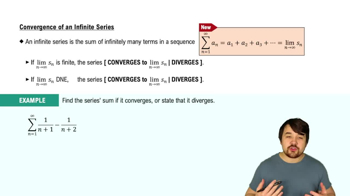
Convergence of an Infinite Series

Remainder (Error) in Infinite Series

The remainder after n terms is the difference between the infinite sum and the nth partial sum. For positive, decreasing terms, the remainder can be bounded to estimate how many terms are needed to achieve a desired accuracy, such as ensuring the remainder is less than 10⁻³.
Recommended video:
06:52
Convergence of an Infinite Series

Integral Test and Remainder Estimate

The integral test compares a series to an improper integral to determine convergence and estimate remainders. For decreasing positive functions, the remainder after n terms is less than the integral from n to infinity of the function, providing a practical way to find the number of terms needed for a given error bound.
Recommended video:
07:25
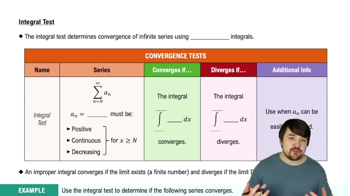
Integral Test
Related Practice
Textbook Question

{Use of Tech} Periodic dosing

Many people take aspirin on a regular basis as a preventive measure for heart disease. Suppose a person takes 80 mg of aspirin every 24 hours. Assume aspirin has a half-life of 24 hours; that is, every 24 hours, half of the drug in the blood is eliminated.


b.Use a calculator to estimate this limit. In the long run, how much drug is in the person’s blood?

44
views
Textbook Question

27–34. Working with sequences Several terms of a sequence {aₙ}ₙ₌₁∞ are given.

b. Find a recurrence relation that generates the sequence (supply the initial value of the index and the first term of the sequence).

{-5, 5, -5, 5, ......}

54
views
Textbook Question

71. Evaluating an infinite series two ways

Evaluate the series

∑ (k = 1 to ∞) (4 / 3ᵏ – 4 / 3ᵏ⁺¹) two ways.


b. Use a geometric series argument with Theorem 10.8.

71
views
Textbook Question

Explain why or why not Determine whether the following statements are true and give an explanation or counterexample.


b. The sum ∑ (k = 3 to ∞) 1 / √(k − 2) is a p-series.

41
views
Textbook Question

{Use of Tech} Fibonacci sequence

The famous Fibonacci sequence was proposed by Leonardo Pisano, also known as Fibonacci, in about A.D. 1200 as a model for the growth of rabbit populations.


It is given by the recurrence relation: fₙ₊₁ = fₙ + fₙ₋₁,for n = 1, 2, 3, … where f₀ = 1 and f₁ = 1. Each term of the sequence is the sum of its two predecessors. 


b.Is the sequence bounded?

70
views
Textbook Question

57–60. Heights of bouncing balls A ball is thrown upward to a height of hₒ meters. After each bounce, the ball rebounds to a fraction r of its previous height. Let hₙ be the height after the nth bounce. Consider the following values of hₒ and r.


b. Find an explicit formula for the nth term of the sequence {hₙ}.


h₀ = 30,r = 0.25

69
views