Ch. 10 - Sequences and Infinite Series
Briggs - Calculus: Early Transcendentals 3rd Edition
Briggs3rd EditionCalculus: Early TranscendentalsISBN: 9780136847243Not the one you use?Change textbook
Chapter 10, Problem 10.4.41c

41–44. {Use of Tech} Remainders and estimates Consider the following convergent series.


c. Find lower and upper bounds (Lₙ and Uₙ, respectively) on the exact value of the series.


41. ∑ (k = 1 to ∞) 1 / k⁶

Verified step by step guidance
1
Recognize that the series \( \sum_{k=1}^{\infty} \frac{1}{k^6} \) is a convergent p-series with \( p = 6 > 1 \), so it converges to a finite value.
To find lower and upper bounds \( L_n \) and \( U_n \) for the sum, consider the partial sum \( S_n = \sum_{k=1}^n \frac{1}{k^6} \) as an approximation to the infinite sum.
Use the integral test remainder estimates: the remainder \( R_n = S - S_n \) satisfies \( \int_{n+1}^{\infty} \frac{1}{x^6} \, dx \leq R_n \leq \int_n^{\infty} \frac{1}{x^6} \, dx \).
Evaluate the improper integrals \( \int_n^{\infty} \frac{1}{x^6} \, dx \) and \( \int_{n+1}^{\infty} \frac{1}{x^6} \, dx \) to find explicit expressions for the upper and lower bounds on the remainder.
Add these remainder bounds to the partial sum \( S_n \) to get the inequalities: \( S_n + \int_{n+1}^{\infty} \frac{1}{x^6} \, dx \leq S \leq S_n + \int_n^{\infty} \frac{1}{x^6} \, dx \), which give the lower bound \( L_n \) and upper bound \( U_n \) for the exact sum.

Verified video answer for a similar problem:

This video solution was recommended by our tutors as helpful for the problem above.
Video duration:
5m
Was this helpful?

Key Concepts

Here are the essential concepts you must grasp in order to answer the question correctly.

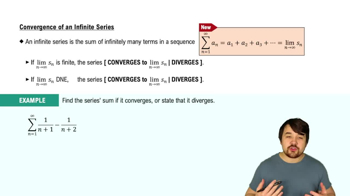
Convergent Infinite Series

A convergent infinite series is a sum of infinitely many terms that approaches a finite limit. For the series ∑ 1/k⁶, since the exponent 6 > 1, the p-series test confirms convergence. Understanding convergence ensures the series sum exists and can be approximated.
Recommended video:
06:52
Convergence of an Infinite Series

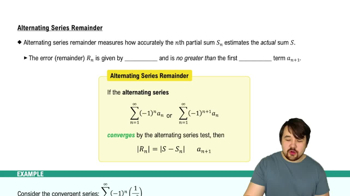
Remainder (Error) Estimation in Series

Remainder estimation provides bounds on the difference between the partial sum and the exact sum of a convergent series. For positive, decreasing terms, the remainder after n terms is less than the next term or can be bounded using integral tests, helping to find upper and lower bounds.
Recommended video:
06:32
Alternating Series Remainder

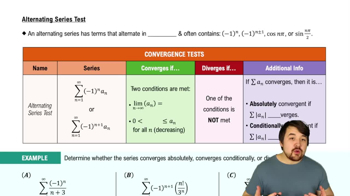
Integral Test for Series Bounds

The integral test compares a series to an improper integral to determine convergence and estimate remainders. For decreasing positive functions, the integral from n to infinity of f(x) dx bounds the remainder, allowing calculation of lower and upper bounds (Lₙ and Uₙ) on the series sum.
Recommended video:
10:54
Alternating Series Test
Related Practice
Textbook Question

{Use of Tech} Drug Dosing

A patient takes 75 mg of a medication every 12 hours; 60% of the medication in the blood is eliminated every 12 hours.


c.Find the limit of the sequence. What is the physical meaning of this limit?

46
views

Textbook Question

72–75. {Use of Tech} Practical sequences

Consider the following situations that generate a sequence


c.Find a recurrence relation that generates the sequence.


Radioactive decay

A material transmutes 50% of its mass to another element every 10 years due to radioactive decay. Let Mₙ be the mass of the radioactive material at the end of the nᵗʰ decade, where the initial mass of the material is M₀ = 20g.

46
views
Textbook Question

Explain why or why not Determine whether the following statements are true and give an explanation or counterexample.


c. A series that converges conditionally must converge.

40
views
Textbook Question

39–40. {Use of Tech} Lower and upper bounds of a series

For each convergent series and given value of n, use Theorem 10.13 to complete the following.


c. Find lower and upper bounds (Lₙ and Uₙ, respectively) for the exact value of the series.


39. ∑ (k = 1 to ∞) 1 / k⁷ ; n = 2

89
views
Textbook Question

Explain why or why not

Determine whether the following statements are true and give an explanation or counterexample.


c.If the terms of the sequence {aₙ} are positive and increasing, then the sequence of partial sums for the series∑⁽∞⁾ₖ₌₁aₖ diverges.

42
views
Textbook Question

27–34. Working with sequences Several terms of a sequence {aₙ}ₙ₌₁∞ are given.

c. Find an explicit formula for the nth term of the sequence.


{1, 3, 9, 27, 81, ......}

60
views