The terms of a sequence of partial sums are defined by Sₙ = ∑ⁿₖ₌₁ k² , for n=1, 2, 3, .....Evaluate the first four terms of the sequence.
Ch. 10 - Sequences and Infinite Series
Briggs3rd EditionCalculus: Early TranscendentalsISBN: 9780136847243Not the one you use?Change textbook
Chapter 10, Problem 10.2.55
55–70. More sequences
Find the limit of the following sequences or determine that the sequence diverges.
{(−1)ⁿ / 2ⁿ}
Verified step by step guidance1
Identify the general term of the sequence, which is given by \(a_n = \frac{(-1)^n}{2^n}\).
Recall that \((-1)^n\) alternates between \(1\) and \(-1\) as \(n\) increases, causing the numerator to alternate signs.
Note that the denominator \$2^n\( grows exponentially as \)n$ increases, becoming very large.
Consider the behavior of the absolute value of the terms: \(\left|a_n\right| = \frac{1}{2^n}\), which approaches \(0\) as \(n \to \infty\).
Since the numerator only changes sign but the magnitude approaches zero, conclude that the sequence converges to \(0\).

Verified video answer for a similar problem:
This video solution was recommended by our tutors as helpful for the problem above.
Video duration:
1mWas this helpful?
Key Concepts
Here are the essential concepts you must grasp in order to answer the question correctly.
Sequence and Limit
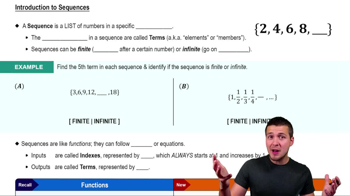
A sequence is an ordered list of numbers defined by a specific formula. The limit of a sequence is the value that the terms approach as the index goes to infinity. Understanding how to find limits helps determine if a sequence converges to a finite value or diverges.
Recommended video:
Guided course
Introduction to Sequences
Behavior of Exponential Terms
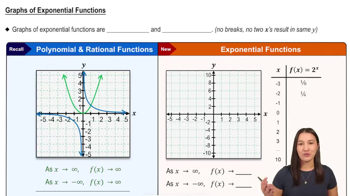
Exponential terms like 2ⁿ grow rapidly as n increases. When in the denominator, such terms cause the overall fraction to approach zero. Recognizing this behavior is key to evaluating limits involving exponential expressions.
Recommended video:
Graphs of Exponential Functions
Alternating Sequences
An alternating sequence changes sign with each term, often represented by (−1)ⁿ. While the sign alternates, the magnitude may approach zero or another value. Understanding this helps analyze whether the sequence converges or oscillates without settling.
Recommended video:
Guided course
Introduction to Sequences
Related Practice
Textbook Question
72
views
Textbook Question
40–62. Choose your test Use the test of your choice to determine whether the following series converge.
∑ (k = 2 to ∞) 1 / (klnk)
55
views
Textbook Question
9–15. Geometric sums Evaluate each geometric sum.
∑ k = 0 to 83ᵏ
41
views
Textbook Question
13–52. Limits of sequences
Find the limit of the following sequences or determine that the sequence diverges.
{(3n³ − 1)⁄(2n³ + 1)}
34
views
Textbook Question
11–86. Applying convergence tests Determine whether the following series converge. Justify your answers.
∑ (from k = 1 to ∞) (−1)ᵏ × k / (k³ + 1)
55
views
Textbook Question
32–49. Choose your test Use the test of your choice to determine whether the following series converge absolutely, converge conditionally, or diverge.
∑ (from k = 1 to ∞) (√k / k − 1)²ᵏ
41
views