
Ch. 10 - Sequences and Infinite Series
Briggs - Calculus: Early Transcendentals 3rd Edition
Briggs3rd EditionCalculus: Early TranscendentalsISBN: 9780136847243Not the one you use?Change textbook
Chapter 10, Problem 10.1.73d

72–75. {Use of Tech} Practical sequences
Consider the following situations that generate a sequence


d.Using a calculator or a graphing utility, estimate the limit of the sequence or state that it does not exist.


Radioactive decay
A material transmutes 50% of its mass to another element every 10 years due to radioactive decay. Let Mₙ be the mass of the radioactive material at the end of the nᵗʰ decade, where the initial mass of the material is M₀ = 20g.

Verified step by step guidance
1
Identify the type of sequence described. Since the material loses 50% of its mass every 10 years, the sequence \( M_n \) represents a geometric sequence where each term is half the previous term.
Write the general formula for the sequence. Given the initial mass \( M_0 = 20 \) grams and the decay factor of 0.5 per decade, the mass at the end of the \( n^{th} \) decade is given by: \[ M_n = M_0 \times (0.5)^n \]
Understand what the limit of the sequence represents. The limit \( \lim_{n \to \infty} M_n \) corresponds to the mass remaining after infinitely many decades, which models the long-term behavior of the radioactive material.
Use a calculator or graphing utility to evaluate the terms of the sequence for large values of \( n \) to observe the trend. This will help estimate the limit by seeing how \( M_n \) behaves as \( n \) increases.
Based on the geometric sequence properties and the decay factor, conclude whether the limit exists and what its value approaches as \( n \to \infty \).

Verified video answer for a similar problem:

This video solution was recommended by our tutors as helpful for the problem above.
Video duration:
3m
Was this helpful?

Key Concepts

Here are the essential concepts you must grasp in order to answer the question correctly.

Sequences and Their Limits

A sequence is an ordered list of numbers generated by a specific rule. The limit of a sequence is the value that the terms approach as the index goes to infinity. Understanding limits helps determine the long-term behavior of sequences, such as whether the mass stabilizes or diminishes to zero in decay problems.
Recommended video:
Guided course
8:22
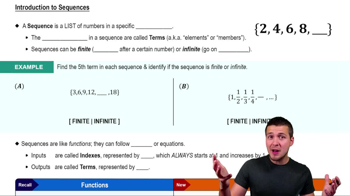
Introduction to Sequences

Exponential Decay

Exponential decay describes processes where a quantity decreases by a fixed percentage over equal time intervals. In radioactive decay, the mass reduces by a constant factor (here, 50%) every decade, modeled by Mₙ = M₀ * (decay factor)ⁿ. This concept is essential for setting up the sequence formula.
Recommended video:
09:29
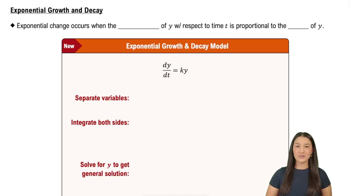
Exponential Growth & Decay

Use of Technology for Estimation

Calculators and graphing utilities can approximate sequence values and their limits when analytical solutions are complex or to verify results. They help visualize the sequence behavior over many terms, making it easier to estimate the limit or conclude if it does not exist.
Recommended video:
07:59
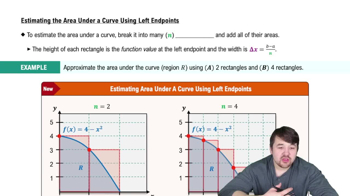
Estimating the Area Under a Curve Using Left Endpoints
Related Practice
Textbook Question

41–44. {Use of Tech} Remainders and estimates Consider the following convergent series.


d. Find an interval in which the value of the series must lie if you approximate it using ten terms of the series.


43. ∑ (k = 1 to ∞) 1 / 3ᵏ

137
views
Textbook Question

72–75. {Use of Tech} Practical sequences

Consider the following situations that generate a sequence


d.Using a calculator or a graphing utility, estimate the limit of the sequence or state that it does not exist.


Drug elimination

Jack took a 200-mg dose of a pain killer at midnight. Every hour, 5% of the drug is washed out of his bloodstream. Let dₙ be the amount of drug in Jack’s blood n hours after the drug was taken, where d₀ = 200mg.

35
views
Textbook Question

87. Explain why or why not

Determine whether the following statements are true and give an explanation or counterexample.


d. If ∑ pᵏ diverges, then ∑ (p + 0.001)ᵏ diverges, for a fixed real number p.

44
views
Textbook Question

Explain why or why not Determine whether the following statements are true and give an explanation or counterexample.

d. If ∑ aₖ diverges, then ∑ |aₖ| diverges.

40
views
Textbook Question

Explain why or why not

Determine whether the following statements are true and give an explanation or counterexample.


d.If {aₙ} = {1, ½, ⅓, ¼, ⅕, …} and

{bₙ} = {1, 0, ½, 0, ⅓, 0, ¼, 0, …},

then limₙ→∞aₙ = limₙ→∞bₙ.

43
views
Textbook Question

41–44. {Use of Tech} Remainders and estimates Consider the following convergent series.


c. Find lower and upper bounds (Lₙ and Uₙ, respectively) on the exact value of the series.


43. ∑ (k = 1 to ∞) 1 / 3ᵏ

147
views