Explain why the magnitude of the remainder in an alternating series (with terms that are nonincreasing in magnitude) is less than or equal to the magnitude of the first neglected term.
Ch. 10 - Sequences and Infinite Series
Briggs3rd EditionCalculus: Early TranscendentalsISBN: 9780136847243Not the one you use?Change textbook
Chapter 10, Problem 10.5.23
9–36. Comparison tests Use the Comparison Test or the Limit Comparison Test to determine whether the following series converge.
∑ (k = 1 to ∞) sin(1 / k) / k²
Verified step by step guidance1
First, identify the general term of the series: \(a_k = \frac{\sin(1/k)}{k^2}\).
Recall that for large \(k\), \(\sin(1/k)\) behaves approximately like \(1/k\) because \(\sin x \approx x\) when \(x\) is close to 0.
Use this approximation to compare \(a_k\) with a simpler series term: \(b_k = \frac{1/k}{k^2} = \frac{1}{k^3}\).
Since \(\sum_{k=1}^\infty \frac{1}{k^3}\) is a p-series with \(p=3 > 1\), it converges.
Apply the Limit Comparison Test by computing \(\lim_{k \to \infty} \frac{a_k}{b_k} = \lim_{k \to \infty} \frac{\sin(1/k)/k^2}{1/k^3} = \lim_{k \to \infty} \frac{\sin(1/k)}{1/k}\). Since this limit is finite and nonzero, both series share the same convergence behavior, so the original series converges.

Verified video answer for a similar problem:
This video solution was recommended by our tutors as helpful for the problem above.
Video duration:
3mWas this helpful?
Key Concepts
Here are the essential concepts you must grasp in order to answer the question correctly.
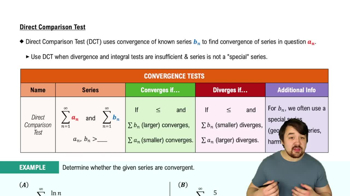
Comparison Test
The Comparison Test determines the convergence of a series by comparing it to a second series with known behavior. If the terms of the given series are smaller than those of a convergent series with positive terms, then the given series also converges. Conversely, if the terms are larger than those of a divergent series, the given series diverges.
Recommended video:
Direct Comparison Test
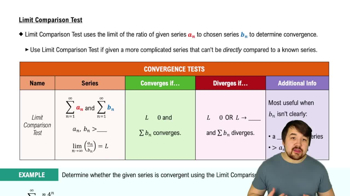
Limit Comparison Test
The Limit Comparison Test compares two series by taking the limit of the ratio of their terms. If this limit is a positive finite number, both series either converge or diverge together. This test is useful when direct comparison is difficult but the terms behave similarly for large indices.
Recommended video:
Limit Comparison Test
Behavior of sin(1/k) for large k
For large values of k, sin(1/k) can be approximated by its argument 1/k because sin(x) ≈ x when x is close to zero. This approximation helps simplify the given series terms to roughly 1/(k³), aiding in the application of comparison tests with p-series.
Recommended video:
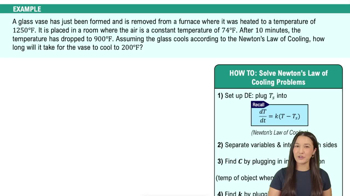
Newton's Law of Cooling Example 5
Related Practice
Textbook Question
86
views
Textbook Question
23–38. Divergence, Integral, and p-series Tests Use the Divergence Test, the Integral Test, or the p-series test to determine whether the following series converge.
∑ (k = 1 to ∞) k / eᵏ
59
views
Textbook Question
13–52. Limits of sequences
Find the limit of the following sequences or determine that the sequence diverges.
{ⁿ√(e³ⁿ⁺⁴)}
34
views
Textbook Question
32–49. Choose your test Use the test of your choice to determine whether the following series converge absolutely, converge conditionally, or diverge.
∑ (from k = 1 to ∞) (−1)ᵏ / k⁰.⁹⁹
33
views
Textbook Question
Simplify k! / (k + 2)! for any integer k ≥ 0.
60
views
Textbook Question
39–44. {Use of Tech} Estimating infinite series Estimate the value of the following convergent series with an absolute error less than 10⁻³.
∑ (k = 1 to ∞) (−1)ᵏ / kᵏ
60
views