
Textbook Question
87. Explain why or why not
Determine whether the following statements are true and give an explanation or counterexample.
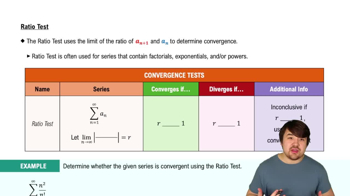
e. ∑ (k = 1 to ∞) (π / e)⁻ᵏ is a convergent geometric series.
45
views

 Verified step by step guidance
 05:35
05:35
 6:04
6:04 06:11
06:1187. Explain why or why not
Determine whether the following statements are true and give an explanation or counterexample.
e. ∑ (k = 1 to ∞) (π / e)⁻ᵏ is a convergent geometric series.
41–44. {Use of Tech} Remainders and estimates Consider the following convergent series.
d. Find an interval in which the value of the series must lie if you approximate it using ten terms of the series.
41. ∑ (k = 1 to ∞) 1 / k⁶
Explain why or why not Determine whether the following statements are true and give an explanation or counterexample.
d. When applying the Limit Comparison Test, an appropriate comparison series for ∑ (k = 1 to ∞) (k² + 2k + 1) / (k⁵ + 5k + 7) is ∑ (k = 1 to ∞) 1 / k³.
Explain why or why not Determine whether the following statements are true and give an explanation or counterexample.
e. If ∑ k⁻ᵖ converges, then ∑ k⁻ᵖ⁺⁰.⁰⁰¹ converges.
Explain why or why not Determine whether the following statements are true and give an explanation or counterexample.
f. If lim (k → ∞) aₖ = 0, then ∑ aₖ converges."
Explain why or why not Determine whether the following statements are true and give an explanation or counterexample.
d. Every partial sum Sₙ of the series ∑ (k = 1 to ∞) 1 / k² underestimates the exact value of ∑ (k = 1 to ∞) 1 / k².