Ch. 10 - Sequences and Infinite Series
Briggs - Calculus: Early Transcendentals 3rd Edition
Briggs3rd EditionCalculus: Early TranscendentalsISBN: 9780136847243Not the one you use?Change textbook
Chapter 10, Problem 10.7.31a

Explain why or why not Determine whether the following statements are true and give an explanation or counterexample.


a. n!n! = (2n)! for all positive integers n.

Verified step by step guidance
1
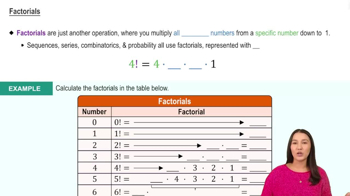
Recall the definition of the factorial function: for a positive integer \(n\), \(n! = 1 \times 2 \times 3 \times \cdots \times n\).
Understand the expressions given: \(n!n!\) means multiplying \(n!\) by itself, while \((2n)!\) means the factorial of \$2n$, which is \(1 \times 2 \times 3 \times \cdots \times (2n)\).
To check if \(n!n! = (2n)!\) for all positive integers \(n\), consider testing small values of \(n\) to see if the equality holds.
For example, when \(n=1\), \(n!n! = 1! \times 1! = 1 \times 1 = 1\) and \((2n)! = (2 \times 1)! = 2! = 2\), so the equality does not hold here.
Since the equality fails for \(n=1\), the statement is false for all positive integers \(n\). This counterexample disproves the statement.

Verified video answer for a similar problem:

This video solution was recommended by our tutors as helpful for the problem above.
Video duration:
3m
Was this helpful?

Key Concepts

Here are the essential concepts you must grasp in order to answer the question correctly.

Factorials and Their Properties

A factorial, denoted n!, is the product of all positive integers from 1 to n. Understanding how factorials grow and their basic properties is essential to compare expressions like n!·n! and (2n)!.
Recommended video:
5:22
Factorials

Inequalities and Growth Rates of Factorials

Factorials grow very rapidly, and (2n)! grows faster than n!·n!. Recognizing this difference helps determine whether n!·n! equals (2n)! or not by comparing their magnitudes.
Recommended video:
5:22
Factorials

Counterexamples in Mathematical Proof

To disprove a statement, providing a single counterexample suffices. Testing the equality for small values of n can quickly show whether the statement holds universally or not.
Recommended video:
05:13
Slopes of Tangent Lines
Related Practice
Textbook Question

Explain why or why not

Determine whether the following statements are true and give an explanation or counterexample.

a.If limₙ→∞aₙ = 1 and limₙ→∞bₙ = 3, then limₙ→∞(bₙ / aₙ) = 3.

48
views

Textbook Question

Explain why or why not

Determine whether the following statements are true and give an explanation or counterexample.

a. If the Limit Comparison Test can be applied successfully to a given series with a certain comparison series, the Comparison Test also works with the same comparison series.

46
views
Textbook Question

87. Explain why or why not

Determine whether the following statements are true and give an explanation or counterexample.


a. If ∑ (k = 1 to ∞) aₖ converges, then ∑ (k = 10 to ∞) aₖ converges.

47
views
Textbook Question

{Use of Tech} Drug Dosing

A patient takes 75 mg of a medication every 12 hours; 60% of the medication in the blood is eliminated every 12 hours.


a.Let dₙ equal the amount of medication (in mg) in the bloodstream after n doses, where d₁ = 75.

Find a recurrence relation for dₙ.

44
views
Textbook Question

27–34. Working with sequences Several terms of a sequence {aₙ}ₙ₌₁∞ are given.

a. Find the next two terms of the sequence.


{1, 3, 9, 27, 81, ......}

48
views
Textbook Question

{Use of Tech} Repeated square roots

Consider the sequence defined by

aₙ₊₁ = √(2 + aₙ),a₀ = √2, for n = 0, 1, 2, 3, …


a.Evaluate the first four terms of the sequence {aₙ}.

State the exact values first, and then the approximate values.

38
views