Define the remainder of an infinite series.
Ch. 10 - Sequences and Infinite Series
Briggs3rd EditionCalculus: Early TranscendentalsISBN: 9780136847243Not the one you use?Change textbook
Chapter 10, Problem 10.2.5
For what values of r does the sequence {rⁿ} converge? Diverge?
Verified step by step guidance1
Recall that the sequence is given by \(a_n = r^n\), where \(n\) is a natural number and \(r\) is a real number parameter.
To determine convergence or divergence, analyze the behavior of \(r^n\) as \(n\) approaches infinity for different values of \(r\).
Consider the cases based on the absolute value of \(r\):
- If \(|r| < 1\), then \(r^n\) approaches 0 as \(n \to \infty\), so the sequence converges to 0.
- If \(|r| = 1\), then:
* If \(r = 1\), the sequence is constant and converges to 1.
* If \(r = -1\), the sequence oscillates between 1 and -1 and does not converge.
- If \(|r| > 1\), then \(r^n\) grows without bound in magnitude, so the sequence diverges.
Summarize the results:
- Converges to 0 if \(|r| < 1\).
- Converges to 1 if \(r = 1\).
- Diverges if \(|r| > 1\) or if \(r = -1\) (due to oscillation).
Therefore, the key step is to analyze the absolute value of \(r\) and apply the limit definition of convergence for sequences.

Verified video answer for a similar problem:
This video solution was recommended by our tutors as helpful for the problem above.
Video duration:
1mWas this helpful?
Key Concepts
Here are the essential concepts you must grasp in order to answer the question correctly.
Definition of Sequence Convergence
A sequence converges if its terms approach a specific finite limit as n approaches infinity. For the sequence {rⁿ}, this means finding values of r for which rⁿ approaches a finite number when n becomes very large.
Recommended video:
Guided course
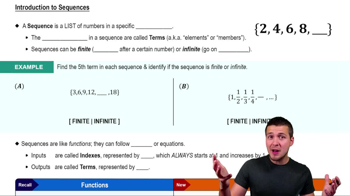
Introduction to Sequences
Behavior of Exponential Sequences
The sequence {rⁿ} is exponential, where each term is r raised to the power n. Its behavior depends on the magnitude of r: if |r| < 1, the terms get smaller and approach zero; if |r| > 1, the terms grow without bound; if |r| = 1, the sequence may oscillate or remain constant.
Recommended video:
Guided course
Introduction to Sequences
Limits Involving Absolute Value
The absolute value of r determines the limit of rⁿ as n approaches infinity. When |r| < 1, rⁿ tends to zero, ensuring convergence. When |r| > 1, rⁿ diverges to infinity or negative infinity. When |r| = 1, the sequence either stays constant (r=1) or oscillates (r=-1), affecting convergence.
Recommended video:
Integrals Involving Natural Logs: Substitution
Related Practice
Textbook Question
103
views
Textbook Question
13–52. Limits of sequences
Find the limit of the following sequences or determine that the sequence diverges.
{tan⁻¹(10n⁄(10n + 4))}
40
views
Textbook Question
6–9. Determine whether the following sequences converge or diverge, and state whether they are monotonic or whether they oscillate. Give the limit when the sequence converges.
{(−0.7)ⁿ}
77
views
Textbook Question
21–42. Geometric series Evaluate each geometric series or state that it diverges.
21.∑ (k = 0 to ∞) (1/4)ᵏ
44
views
Textbook Question
32–49. Choose your test Use the test of your choice to determine whether the following series converge absolutely, converge conditionally, or diverge.
∑ (from k = 1 to ∞) (−1)ᵏ k³ / √(k⁸ + 1)
37
views
Textbook Question
Given the series ∑∞ₖ₌₁ k, evaluate the first four terms of its sequence of partial sums Sₙ = ∑ⁿₖ₌₁ k.
57
views