Explain why the magnitude of the remainder in an alternating series (with terms that are nonincreasing in magnitude) is less than or equal to the magnitude of the first neglected term.
Ch. 10 - Sequences and Infinite Series
Briggs3rd EditionCalculus: Early TranscendentalsISBN: 9780136847243Not the one you use?Change textbook
Chapter 10, Problem 10.2.77
Growth rates of sequences
Use Theorem 10.6 to find the limit of the following sequences or state that they diverge.
{n¹⁰ / ln20n}
Verified step by step guidance1
Identify the sequence given: \(a_n = \frac{n^{10}}{\ln(20n)}\).
Recall Theorem 10.6, which typically deals with growth rates of sequences involving polynomials and logarithmic functions. It states that polynomial functions grow faster than logarithmic functions as \(n \to \infty\).
Analyze the numerator and denominator separately: the numerator \(n^{10}\) grows very quickly (polynomial growth), while the denominator \(\ln(20n)\) grows slowly (logarithmic growth).
Since the numerator grows much faster than the denominator, the fraction \(\frac{n^{10}}{\ln(20n)}\) increases without bound as \(n\) becomes very large.
Conclude that the limit of the sequence \(a_n\) as \(n \to \infty\) is \(+\infty\), meaning the sequence diverges to infinity.

Verified video answer for a similar problem:
This video solution was recommended by our tutors as helpful for the problem above.
Video duration:
1mWas this helpful?
Key Concepts
Here are the essential concepts you must grasp in order to answer the question correctly.
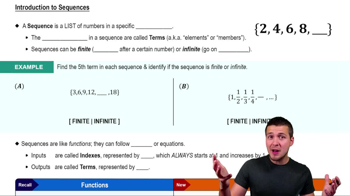
Limits of Sequences
The limit of a sequence describes the value that the terms approach as the index goes to infinity. Understanding how to evaluate limits helps determine whether a sequence converges to a finite number or diverges to infinity or does not settle.
Recommended video:
Guided course
Introduction to Sequences
Growth Rates of Functions
Comparing growth rates involves analyzing how fast functions like polynomials, logarithms, and exponentials increase as their input grows. Polynomials grow faster than logarithmic functions, which is crucial for determining the behavior of sequences involving these terms.
Recommended video:
Intro To Related Rates
Theorem 10.6 (Comparison of Growth Rates)
Theorem 10.6 typically states that for large n, polynomial functions dominate logarithmic functions, meaning n^k grows faster than ln(n) for any positive integer k. This theorem helps conclude that sequences with polynomial numerators and logarithmic denominators tend to infinity.
Recommended video:
Intro To Related Rates
Related Practice
Textbook Question
86
views
Textbook Question
21–42. Geometric series Evaluate each geometric series or state that it diverges.
41.∑ (k = 1 to ∞) 4 / 12ᵏ
42
views
Textbook Question
What comparison series would you use with the Limit Comparison Test to determine whether ∑ (k = 1 to ∞) (k² + k + 5) / (k³ + 3k + 1) converges?
59
views
Textbook Question
49–50. Limits from graphs Consider the following sequences. Find the first four terms of the sequence .Based on part (a) and the figure, determine a plausible limit of the sequence.
aₙ = 2 + 2⁻ⁿ;n = 1, 2, 3, …
56
views
Textbook Question
11–86. Applying convergence tests Determine whether the following series converge. Justify your answers.
∑ (from k = 1 to ∞) k⁴ / (eᵏ⁵)
66
views
Textbook Question
13–52. Limits of sequences
Find the limit of the following sequences or determine that the sequence diverges.
{ⁿ√(e³ⁿ⁺⁴)}
34
views