
Ch. 10 - Sequences and Infinite Series
Briggs - Calculus: Early Transcendentals 3rd Edition
Briggs3rd EditionCalculus: Early TranscendentalsISBN: 9780136847243Not the one you use?Change textbook
Chapter 10, Problem 10.R.19

12–24. Limits of sequences Evaluate the limit of the sequence or state that it does not exist.
aₙ = ((3n² + 2n + 1) · sin(n)) / (4n³ + n) (Hint: Use the Squeeze Theorem.)

Verified step by step guidance
1
Identify the given sequence: \(a_n = \frac{(3n^2 + 2n + 1) \cdot \sin(n)}{4n^3 + n}\).
Analyze the behavior of the numerator and denominator separately as \(n\) approaches infinity. The numerator grows roughly like \$3n^2\( times \(\sin(n)\), and the denominator grows like \)4n^3$.
Note that \(\sin(n)\) oscillates between \(-1\) and \(1\), so \(-1 \leq \sin(n) \leq 1\). Use this to create inequalities for \(a_n\):
\[-\frac{3n^2 + 2n + 1}{4n^3 + n} \leq a_n \leq \frac{3n^2 + 2n + 1}{4n^3 + n}.\]
Simplify the bounding expressions by dividing numerator and denominator by \(n^3\) to understand their limits:
\[-\frac{3/n + 2/n^2 + 1/n^3}{4 + 1/n^2} \leq a_n \leq \frac{3/n + 2/n^2 + 1/n^3}{4 + 1/n^2}.\]
Apply the Squeeze Theorem: since both bounds approach \(0\) as \(n \to \infty\), conclude that \(\lim_{n \to \infty} a_n = 0\).

Verified video answer for a similar problem:

This video solution was recommended by our tutors as helpful for the problem above.
Video duration:
3m
Was this helpful?

Key Concepts

Here are the essential concepts you must grasp in order to answer the question correctly.

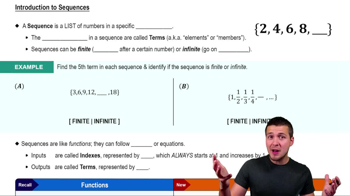
Limits of Sequences

The limit of a sequence describes the value that the terms of the sequence approach as the index n goes to infinity. If the terms get arbitrarily close to a specific number, the sequence converges to that limit; otherwise, it diverges.
Recommended video:
Guided course
8:22
Introduction to Sequences

Squeeze Theorem

The Squeeze Theorem helps find limits by 'trapping' a sequence between two others that have the same limit. If aₙ ≤ bₙ ≤ cₙ for all n beyond some point, and both aₙ and cₙ converge to L, then bₙ also converges to L.
Recommended video:
06:11
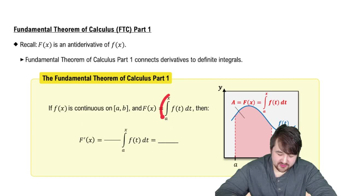
Fundamental Theorem of Calculus Part 1

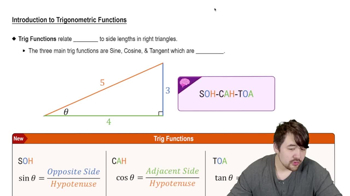
Behavior of Trigonometric Functions in Limits

Trigonometric functions like sin(n) oscillate between -1 and 1 and do not have limits as n approaches infinity. When combined with sequences that tend to zero, their bounded nature allows the use of the Squeeze Theorem to evaluate the overall limit.
Recommended video:
6:04
Introduction to Trigonometric Functions
Related Practice
Textbook Question

{Use of Tech} A savings plan

James begins a savings plan in which he deposits \(100 at the beginning of each month into an account that earns 9% interest annually, or equivalently, 0.75% per month.

To be clear, on the first day of each month, the bank adds 0.75% of the current balance as interest, and then James deposits \)100.


Let Bₙ be the balance in the account after the nᵗʰ payment, where B₀ = \$0.


a.Write the first five terms of the sequence {Bₙ}.

57
views
Textbook Question

27–37. Evaluating series Evaluate the following infinite series or state that the series diverges.

∑ (from k = 0 to ∞)(tan⁻¹(k + 2) − tan⁻¹k)

81
views
Textbook Question

27–37. Evaluating series Evaluate the following infinite series or state that the series diverges.

∑ (from k = 0 to ∞)((1/3)ᵏ + (4/3)ᵏ)

51
views
Textbook Question

27–34. Working with sequences Several terms of a sequence {aₙ}ₙ₌₁∞ are given.

a. Find the next two terms of the sequence.

{1, 2, 4, 8, 16, ......}

54
views
Textbook Question

41–44. {Use of Tech} Remainders and estimates Consider the following convergent series.


a. Find an upper bound for the remainder in terms of n.


41. ∑ (k = 1 to ∞) 1 / k⁶

105
views
Textbook Question

89–90. {Use of Tech} Lower and upper bounds of a series

For each convergent series and given value of n, complete the following.


c. Find lower and upper bounds (Lₙ and Uₙ respectively) for the exact value of the series.


89.∑ (from k = 1 to ∞)1 / k⁵ ;n = 5

104
views