
Textbook Question
Taylor polynomials Find the nth-order Taylor polynomial for the following functions centered at the given point a.
ƒ(x) = e^(sin x), n = 2, a = 0
62
views

 Verified step by step guidance
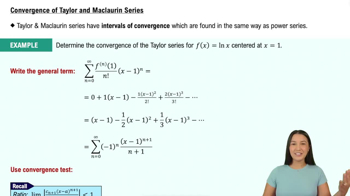
 08:26
08:26
 06:52
06:52 06:00
06:00Taylor polynomials Find the nth-order Taylor polynomial for the following functions centered at the given point a.
ƒ(x) = e^(sin x), n = 2, a = 0
Approximating ln 2 Consider the following three ways to approximate
ln 2.
b. Use the Taylor series for ln (1 - x) centered at 0 and the identity ln 2 = -ln 1/2. Write the resulting infinite series.
Limits by power series Use Taylor series to evaluate the following limits.
lim ₙ → ₄ ln (x - 3)/(x² - 16)
Find the remainder term Rₙ(x) for the Taylor series centered at 0 for the following functions. Find an upper bound for the magnitude of the remainder on the given interval for the given value of n. (The bound is not unique.)
ƒ(x) = eˣ; bound R₃(x), for |x| < 1
Power series from the geometric series Use the geometric series a Σₖ ₌ ₀ ∞ (x)ᵏ = 1/(1 - x), for |x| < 1, to determine the Maclaurin series and the interval of convergence for the following functions.
ƒ(x) = ln (1 - 4x)
ƒ(x) = eˣ, a = 0; e-0.08
b. Use the Taylor polynomials to approximate the given expression. Make a table showing the approximations and the absolute error in these approximations using a calculator for the exact function value.