
Textbook Question
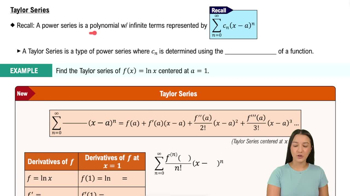
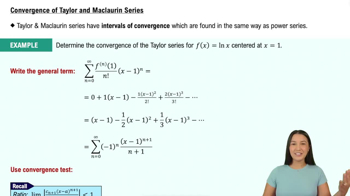
How are the Taylor polynomials for a function f centered at a related to the Taylor series of the function f centered at a?
56
views

 Verified step by step guidance
 08:42
08:42
 08:26
08:26 06:00
06:00How are the Taylor polynomials for a function f centered at a related to the Taylor series of the function f centered at a?
Working with binomial series Use properties of power series, substitution, and factoring to find the first four nonzero terms of the Maclaurin series for the following functions. Use the Maclaurin series
(1 + x)⁻² = 1 − 2x + 3x² − 4x³ + ⋯, for −1 < x < 1.
1/(3 + 4x)²
Tangent line is p₁ Let f be differentiable at x=a
a. Find the equation of the line tangent to the curve y=f(x) at (a, f(a)).
b. Verify that the Taylor polynomial p_1 centered at a describes the tangent line found in part (a).
Power series for derivatives
a. Differentiate the Taylor series centered at 0 for the following functions.
b. Identify the function represented by the differentiated series.
c. Give the interval of convergence of the power series for the derivative.
f(x) = ln (1 + x)
{Use of Tech} Maximum error Use the remainder term to find a bound on the error in the following approximations on the given interval. Error bounds are not unique.
√(1+x) ≈ 1 + x/2 on [−0.1,0.1]
{Use of Tech} Estimating errors Use the remainder to find a bound on the error in approximating the following quantities with the nth-order Taylor polynomial centered at 0. Estimates are not unique.
e⁰ᐧ²⁵, n=4