
Ch. 11 - Power Series
Briggs - Calculus: Early Transcendentals 3rd Edition
Briggs3rd EditionCalculus: Early TranscendentalsISBN: 9780136847243Not the one you use?Change textbook
Chapter 11, Problem 11.2.47

Combining power series Use the power series representation


f(x ) =ln (1 − x) = −∑ₖ₌₁∞ xᵏ/k, for −1 ≤ x < 1,


to find the power series for the following functions (centered at 0). Give the interval of convergence of the new series.


f(3x) = ln (1 − 3x)

Verified step by step guidance
1
Recall the given power series representation for the function \(f(x) = \ln(1 - x)\), which is \(f(x) = -\sum_{k=1}^{\infty} \frac{x^k}{k}\), valid for \(-1 \leq x < 1\).
To find the power series for \(f(3x) = \ln(1 - 3x)\), substitute \$3x\( in place of \)x$ in the original series. This gives \(f(3x) = -\sum_{k=1}^{\infty} \frac{(3x)^k}{k}\).
Rewrite the series by expanding the term \((3x)^k\) as \$3^k x^k$, so the series becomes \(f(3x) = -\sum_{k=1}^{\infty} \frac{3^k x^k}{k}\).
Determine the interval of convergence for the new series by considering the original interval \(-1 \leq x < 1\) and substituting \$3x\( for \)x\(. This means the inequality \)|3x| < 1$ must hold, which simplifies to \(|x| < \frac{1}{3}\).
Therefore, the power series for \(f(3x)\) is \(-\sum_{k=1}^{\infty} \frac{3^k x^k}{k}\), and its interval of convergence is \(\left(-\frac{1}{3}, \frac{1}{3}\right)\).

Verified video answer for a similar problem:

This video solution was recommended by our tutors as helpful for the problem above.
Video duration:
6m
Was this helpful?

Key Concepts

Here are the essential concepts you must grasp in order to answer the question correctly.

Power Series Representation

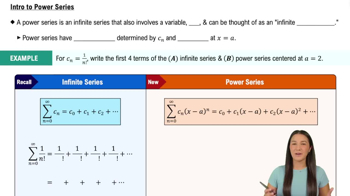
A power series expresses a function as an infinite sum of terms involving powers of a variable, typically centered at a point (often zero). For example, ln(1 - x) can be written as -∑(x^k / k) for k=1 to ∞, valid within its radius of convergence. Understanding this allows manipulation and substitution within the series.
Recommended video:
05:58
Intro to Power Series

Substitution in Power Series

Substitution involves replacing the variable in a power series with another expression, such as replacing x by 3x. This changes each term's power accordingly and affects the interval of convergence. Correct substitution is essential to find the new series representation of functions like f(3x).
Recommended video:
05:58
Intro to Power Series

Interval of Convergence

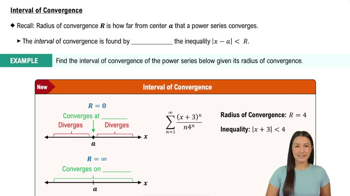
The interval of convergence is the set of x-values for which a power series converges to the function. When substituting variables, the interval changes based on the new variable's domain. Determining this interval ensures the validity of the power series representation for the modified function.
Recommended video:
08:44
Interval of Convergence
Related Practice
Textbook Question

Working with binomial series Use properties of power series, substitution, and factoring to find the first four nonzero terms of the Maclaurin series for the following functions. Give the interval of convergence for the new series (Theorem 11.4 is useful). Use the Maclaurin series


√(1 + x) = 1 + x/2 − x²/8 + x³/16 − ⋯, −1 ≤ x ≤ 1.


√(9 − 9x)

60
views
Textbook Question

Functions to power series Find power series representations centered at 0 for the following functions using known power series. Give the interval of convergence for the resulting series.

f(x) = ln √(1 − x²)

97
views
Textbook Question

Differential equations


a. Find a power series for the solution of the following differential equations, subject to the given initial condition

b. Identify the function represented by the power series.


y′(t) − 3y = 10, y(0) = 2

43
views
Textbook Question

Is ∑ₖ₌₀ ∞ (5x − 20)ᵏ a power series? If so, find the center a of the power series and state a formula for the coefficients cₖ of the power series.

67
views
Textbook Question

Use of Tech Linear and quadratic approximation


a. Find the linear approximating polynomial for the following functions centered at the given point a.


b. Find the quadratic approximating polynomial for the following functions centered at a.


c Use the polynomials obtained in parts (a) and (b) to approximate the given quantity.


f(x)=e⁻²ˣ, a=0; approximate e⁻⁰ᐧ².

56
views
Textbook Question

Radius of convergence Find the radius of convergence for the following power series.

∑ₖ₌₁∞ (1−cos (1/2ᵏ)) xᵏ

70
views