
Ch. 11 - Power Series
Briggs - Calculus: Early Transcendentals 3rd Edition
Briggs3rd EditionCalculus: Early TranscendentalsISBN: 9780136847243Not the one you use?Change textbook
Chapter 11, Problem 11.4.22

Limits Evaluate the following limits using Taylor series.
lim ₓ→∞ x(e¹/ˣ − 1)

Verified step by step guidance
1
Recognize that the limit involves the expression \(x \left(e^{1/x} - 1\right)\) as \(x\) approaches infinity, which suggests using the Taylor series expansion of the exponential function around 0.
Recall the Taylor series expansion for \(e^t\) around \(t=0\): \[e^t = 1 + t + \frac{t^2}{2!} + \frac{t^3}{3!} + \cdots\]
Substitute \(t = \frac{1}{x}\) into the series to get: \[e^{1/x} = 1 + \frac{1}{x} + \frac{1}{2x^2} + \frac{1}{6x^3} + \cdots\]
Rewrite the original expression using this expansion: \[x \left(e^{1/x} - 1\right) = x \left(\frac{1}{x} + \frac{1}{2x^2} + \frac{1}{6x^3} + \cdots \right)\]
Simplify the expression by multiplying \(x\) inside the parentheses and then analyze the behavior of each term as \(x \to \infty\) to determine the limit.

Verified video answer for a similar problem:

This video solution was recommended by our tutors as helpful for the problem above.
Video duration:
3m
Was this helpful?

Key Concepts

Here are the essential concepts you must grasp in order to answer the question correctly.

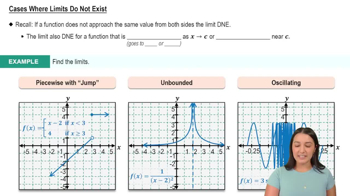
Limits at Infinity

Limits at infinity describe the behavior of a function as the input grows without bound. Understanding how functions behave as x approaches infinity helps determine if the function approaches a finite value, infinity, or does not exist.
Recommended video:
03:07
Cases Where Limits Do Not Exist

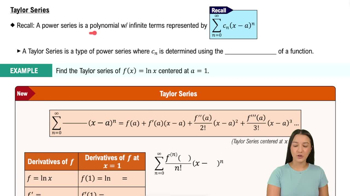
Taylor Series Expansion

A Taylor series represents a function as an infinite sum of terms calculated from its derivatives at a single point. It approximates functions near that point, allowing simplification of complex expressions, especially useful for evaluating limits.
Recommended video:
08:42
Taylor Series

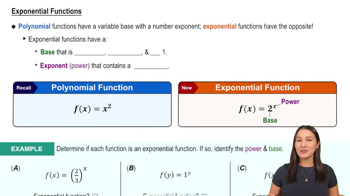
Exponential Function and Its Expansion

The exponential function e^x can be expanded as a Taylor series: e^x = 1 + x + x²/2! + ... . For small values of x, this expansion helps approximate e^(1/x) and analyze the limit by substituting the series into the expression.
Recommended video:
6:13
Exponential Functions