
Ch. 11 - Power Series
Briggs - Calculus: Early Transcendentals 3rd Edition
Briggs3rd EditionCalculus: Early TranscendentalsISBN: 9780136847243Not the one you use?Change textbook
Chapter 11, Problem 11.4.66

Limits with a parameter Use Taylor series to evaluate the following limits. Express the result in terms of the nonzero real parameter(s).
lim ₓ→₀ (eᵃˣ − 1)/x

Verified step by step guidance
1
Identify the limit expression: \(\lim_{x \to 0} \frac{e^{a x} - 1}{x}\), where \(a\) is a nonzero real parameter.
Recall the Taylor series expansion of the exponential function around \(x=0\): \(e^{a x} = 1 + a x + \frac{(a x)^2}{2!} + \frac{(a x)^3}{3!} + \cdots\).
Substitute the Taylor series expansion into the limit expression: \(\frac{e^{a x} - 1}{x} = \frac{\left(1 + a x + \frac{(a x)^2}{2!} + \cdots \right) - 1}{x} = \frac{a x + \frac{(a x)^2}{2!} + \cdots}{x}\).
Simplify the fraction by dividing each term in the numerator by \(x\): \(\frac{a x}{x} + \frac{(a x)^2}{2! x} + \cdots = a + \frac{a^2 x}{2!} + \cdots\).
Evaluate the limit as \(x \to 0\): since all terms involving \(x\) vanish, the limit simplifies to \(a\).

Verified video answer for a similar problem:

This video solution was recommended by our tutors as helpful for the problem above.
Video duration:
2m
Was this helpful?

Key Concepts

Here are the essential concepts you must grasp in order to answer the question correctly.

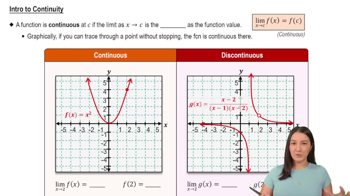
Limits and Continuity

Limits describe the behavior of a function as the input approaches a particular value. Understanding how to evaluate limits, especially when direct substitution leads to indeterminate forms like 0/0, is essential for analyzing function behavior near specific points.
Recommended video:
05:34
Intro to Continuity

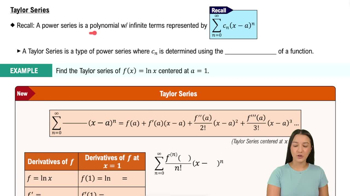
Taylor Series Expansion

A Taylor series represents a function as an infinite sum of terms calculated from its derivatives at a single point. Using the Taylor series around zero (Maclaurin series) helps approximate functions near that point, simplifying limit evaluation by replacing complex expressions with polynomial forms.
Recommended video:
08:42
Taylor Series

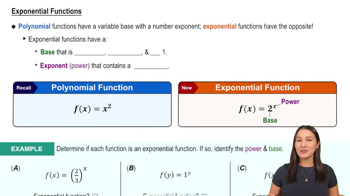
Exponential Function and Parameters

The exponential function e^(ax) depends on the parameter 'a' and variable 'x'. Understanding how the parameter affects the function's behavior and its derivatives is crucial when expressing limits in terms of 'a', especially when using series expansions to evaluate limits involving parameters.
Recommended video:
6:13
Exponential Functions