
Ch. 11 - Power Series
Briggs - Calculus: Early Transcendentals 3rd Edition
Briggs3rd EditionCalculus: Early TranscendentalsISBN: 9780136847243Not the one you use?Change textbook
Chapter 11, Problem 11.1.67d

Matching functions with polynomials Match functions a–f with Taylor polynomials A–F (all centered at 0). Give reasons for your choices.


d. 1/(1 + 2x)


A. p₂(x)= 1 + 2x + 2x²
B. p₂(x) = 1 − 6x + 24x²
C. p₂(x) = 1 + x − x²/2
D. p₂(x) = 1 − 2x + 4x²
E. p₂(x) = 1 − x + (3/2)x²
F. p₂(x) = 1 − 2x + 2x²

Verified step by step guidance
1
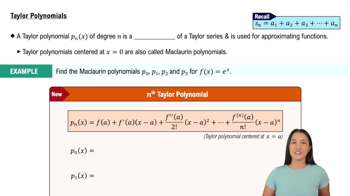
Recall that the Taylor polynomial of a function \(f(x)\) centered at 0 (Maclaurin polynomial) up to degree 2 is given by: \[f(0) + f'(0)x + \frac{f''(0)}{2}x^2\]
Identify the function given: \[f(x) = \frac{1}{1 + 2x}\]
Calculate the value of the function at 0: \[f(0) = \frac{1}{1 + 0} = 1\]
Find the first derivative of \(f(x)\): \[f'(x) = -\frac{2}{(1 + 2x)^2}\] Then evaluate at 0: \[f'(0) = -2\]
Find the second derivative of \(f(x)\): \[f''(x) = \frac{8}{(1 + 2x)^3}\] Then evaluate at 0: \[f''(0) = 8\] Use these to write the Taylor polynomial: \[p_2(x) = 1 - 2x + \frac{8}{2}x^2 = 1 - 2x + 4x^2\] Match this with the given polynomials to find the correct one.

Verified video answer for a similar problem:

This video solution was recommended by our tutors as helpful for the problem above.
Video duration:
3m
Was this helpful?

Key Concepts

Here are the essential concepts you must grasp in order to answer the question correctly.

Taylor Polynomials

Taylor polynomials approximate functions near a specific point (here, 0) using derivatives. The nth-degree Taylor polynomial uses derivatives up to order n to create a polynomial that matches the function's value and slope behavior at that point, providing a local approximation.
Recommended video:
07:00
Taylor Polynomials

Derivatives and Their Role in Taylor Series

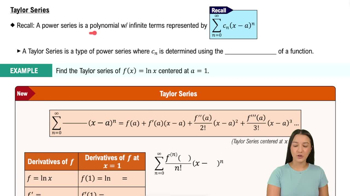
Derivatives of a function at the center point determine the coefficients of the Taylor polynomial. The first derivative gives the linear term coefficient, the second derivative gives the quadratic term coefficient (divided by 2!), and so on, reflecting the function's curvature and rate of change.
Recommended video:
08:42
Taylor Series

Geometric Series and Rational Functions

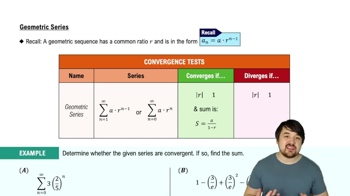
Functions like 1/(1 + 2x) can be expressed as a geometric series when |2x| < 1, allowing expansion into a power series. Recognizing this helps find the Taylor polynomial by truncating the series to the desired degree, linking rational functions to polynomial approximations.
Recommended video:
06:00
Geometric Series
Related Practice
Textbook Question

Explain why or why not Determine whether the following statements are true and give an explanation or counterexample.

c. If f has a Taylor series that converges only on (−2,2), then f(x²) has a Taylor series that also converges only on (−2,2).

60
views
Textbook Question

Explain why or why not Determine whether the following statements are true and give an explanation or counterexample.

d. Suppose f'' is continuous on an interval that contains a, where f has an inflection point at a. Then the second−order Taylor polynomial for f at a is linear.

49
views
Textbook Question

{Use of Tech} Bessel functions Bessel functions arise in the study of wave propagation in circular geometries (for example, waves on a circular drum head). They are conveniently defined as power series. One of an infinite family of Bessel functions is

J₀(x) = ∑ₖ₌₀∞ (−1)ᵏ/(2²ᵏ(k!)²) x²ᵏ

c. Differentiate J₀ twice and show (by keeping terms through x⁶) that J₀ satisfies the equation x² y′′(x) + xy′(x) + x²y(x)=0.

54
views
Textbook Question

Explain why or why not Determine whether the following statements are true and give an explanation or counterexample.

d. If p(x) is the Taylor series for f centered at 0, then p(x−1) is the Taylor series for f centered at 1.

43
views
Textbook Question

Taylor series and interval of convergence


c. Determine the interval of convergence of the series.


f(x)=2/(1−x)³, a=0

43
views
Textbook Question

Explain why or why not Determine whether the following statements are true and give an explanation or counterexample.


If f(x)=∑ₖ₌₀∞ cₖ xᵏ=0, for all x on an interval (−a, a), then cₖ = 0, for all k.

62
views