
Textbook Question
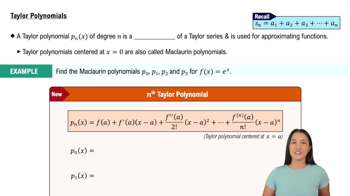
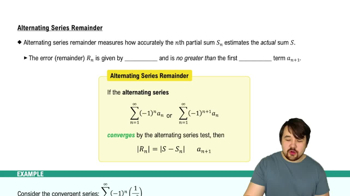
Remainders Find the remainder in the Taylor series centered at the point a for the following functions. Then show that lim ₙ→∞ Rₙ(x)=0, for all x in the interval of convergence.
f(x) = e⁻ˣ, a = 0
66
views

 Verified step by step guidance
 07:00
07:00
 06:32
06:32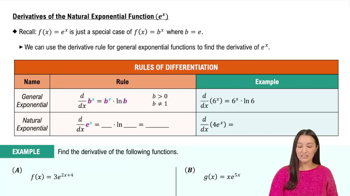 04:56
04:56Remainders Find the remainder in the Taylor series centered at the point a for the following functions. Then show that lim ₙ→∞ Rₙ(x)=0, for all x in the interval of convergence.
f(x) = e⁻ˣ, a = 0
Radius and interval of convergence Determine the radius and interval of convergence of the following power series.
∑ₖ₌₀∞ (2x)ᵏ/k!
How are the Taylor polynomials for a function f centered at a related to the Taylor series of the function f centered at a?
{Use of Tech} Maximum error Use the remainder term to find a bound on the error in the following approximations on the given interval. Error bounds are not unique.
√(1+x) ≈ 1 + x/2 on [−0.1,0.1]
{Use of Tech} Estimating errors Use the remainder to find a bound on the error in approximating the following quantities with the nth-order Taylor polynomial centered at 0. Estimates are not unique.
e⁰ᐧ²⁵, n=4
Use of Tech Linear and quadratic approximation
a. Find the linear approximating polynomial for the following functions centered at the given point a.
b. Find the quadratic approximating polynomial for the following functions centered at a.
c Use the polynomials obtained in parts (a) and (b) to approximate the given quantity.
f(x) = cos x, a = π/4; approximate cos (0.24π)