
Ch. 11 - Power Series
Briggs - Calculus: Early Transcendentals 3rd Edition
Briggs3rd EditionCalculus: Early TranscendentalsISBN: 9780136847243Not the one you use?Change textbook
Chapter 11, Problem 11.1.45

Remainders Find the remainder Rₙ for the nth−order Taylor polynomial centered at a for the given functions. Express the result for a general value of n.


f(x) = sin x, a = π/2

Verified step by step guidance
1
Recall that the remainder term \( R_n(x) \) for the nth-order Taylor polynomial of a function \( f(x) \) centered at \( a \) is given by the Lagrange form of the remainder: \[ R_n(x) = \frac{f^{(n+1)}(c)}{(n+1)!} (x - a)^{n+1} \] where \( c \) is some value between \( a \) and \( x \).
Identify the function and the center: here, \( f(x) = \sin x \) and \( a = \frac{\pi}{2} \). We need to find the \( (n+1) \)-th derivative of \( \sin x \).
Determine the pattern of derivatives of \( \sin x \): \[ f(x) = \sin x \] \[ f'(x) = \cos x \] \[ f''(x) = -\sin x \] \[ f^{(3)}(x) = -\cos x \] \[ f^{(4)}(x) = \sin x \] Notice the derivatives repeat every 4 steps. Use this cyclic pattern to express \( f^{(n+1)}(x) \) in terms of \( \sin x \) or \( \cos x \) with appropriate signs.
Evaluate \( f^{(n+1)}(c) \) at some \( c \) between \( a = \frac{\pi}{2} \) and \( x \). Since \( c \) is unknown but lies in this interval, keep \( f^{(n+1)}(c) \) in the expression to represent the remainder.
Write the remainder term explicitly as: \[ R_n(x) = \frac{f^{(n+1)}(c)}{(n+1)!} (x - \frac{\pi}{2})^{n+1} \] where \( f^{(n+1)}(c) \) follows the derivative pattern of \( \sin x \) and \( c \) is between \( \frac{\pi}{2} \) and \( x \). This expression represents the remainder for the nth-order Taylor polynomial centered at \( \frac{\pi}{2} \).

Verified video answer for a similar problem:

This video solution was recommended by our tutors as helpful for the problem above.
Video duration:
5m
Was this helpful?

Key Concepts

Here are the essential concepts you must grasp in order to answer the question correctly.

Taylor Polynomial and Taylor Series

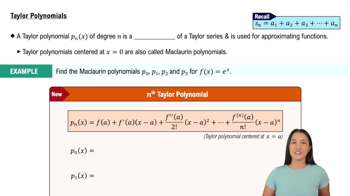
A Taylor polynomial approximates a function near a point a using derivatives of the function at a. The nth-order Taylor polynomial includes terms up to the nth derivative, providing a polynomial approximation of the function around a. Understanding this helps in constructing the polynomial for sin x centered at π/2.
Recommended video:
07:00
Taylor Polynomials

Remainder Term (Lagrange Form)

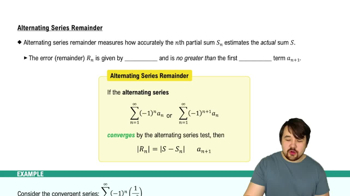
The remainder term Rₙ measures the error between the actual function and its nth-order Taylor polynomial. The Lagrange form expresses Rₙ as a function involving the (n+1)th derivative evaluated at some point between a and x, helping to bound or express the error explicitly.
Recommended video:
06:32
Alternating Series Remainder

Derivatives of sin x and their Patterns

The derivatives of sin x cycle every four steps: sin x, cos x, -sin x, -cos x, then repeat. Recognizing this pattern is essential to find the (n+1)th derivative needed for the remainder term when centered at π/2, simplifying the expression of Rₙ.
Recommended video:
04:56
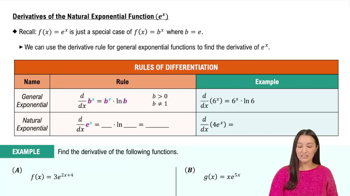
Derivative of the Natural Exponential Function (e^x)
Related Practice
Textbook Question

L'Hôpital's Rule by Taylor series Suppose f and g have Taylor series about the point a.

a. If f(a) = g(a) = 0 and g′(a) ≠ 0, evaluate lim ₓ→ₐ f(x)/g(x) by expanding f and g in their Taylor series. Show that the result is consistent withl’Hôpital’s Rule.

b. If f(a) = g(a) =f′(a) = g′(a) = 0 and g′′(a) ≠ 0, evaluate lim ₓ→ₐ f(x)/g(x) by expanding f and g in their Taylor series. Show that the result is consistent with two applications of 1'Hôpital's Rule.

55
views
Textbook Question

Derivative trick Here is an alternative way to evaluate higher derivatives of a function f that may save time. Suppose you can find the Taylor series for f centered at the point a without evaluating derivatives (for example, from a known series). Then f⁽ᵏ⁾(a)=k! multiplied by the coefficient of (x−a)ᵏ. Use this idea to evaluate f⁽³⁾(0) and f⁽⁴⁾(0) for the following functions. Use known series and do not evaluate derivatives.


f(x) = ∫₀ˣ sin t² dt

74
views
Textbook Question

Radius and interval of convergence Determine the radius and interval of convergence of the following power series.

∑ₖ₌₀∞ k(x−1)ᵏ

71
views
Textbook Question

Power series for derivatives


a. Differentiate the Taylor series centered at 0 for the following functions.

b. Identify the function represented by the differentiated series.

c. Give the interval of convergence of the power series for the derivative.


f(x) = eˣ

47
views
Textbook Question

Does the accuracy of an approximation given by a Taylor polynomial generally increase or decrease with the order of the approximation? Explain.

84
views
Textbook Question

Limits Evaluate the following limits using Taylor series.

lim ₓ→₄ (x² 16)/(ln (x 3)}

75
views