Ch. 11 - Power Series
Briggs - Calculus: Early Transcendentals 3rd Edition
Briggs3rd EditionCalculus: Early TranscendentalsISBN: 9780136847243Not the one you use?Change textbook
Chapter 11, Problem 11.2.65

Shifting power series If the power series f(x)=∑ cₖ xᵏ has an interval of convergence of |x|<R, what is the interval of convergence of the power series for f(x−a), where a ≠ 0 is a real number?

Verified step by step guidance
1
Recall that the original power series is given by \(f(x) = \sum_{k=0}^{\infty} c_k x^k\) and it converges for \(|x| < R\) where \(R\) is the radius of convergence.
When we consider the shifted function \(f(x - a)\), we rewrite the series as \(f(x - a) = \sum_{k=0}^{\infty} c_k (x - a)^k\).
The key observation is that the power series is now centered at \(x = a\) instead of \(x = 0\), because the variable inside the series is \((x - a)\).
The radius of convergence remains the same, \(R\), but the interval shifts accordingly. So the new interval of convergence is all \(x\) such that \(|x - a| < R\).
Therefore, the interval of convergence for \(f(x - a)\) is the open interval \((a - R, a + R)\), which is the original interval shifted by \(a\).

Verified video answer for a similar problem:

This video solution was recommended by our tutors as helpful for the problem above.
Video duration:
2m
Was this helpful?

Key Concepts

Here are the essential concepts you must grasp in order to answer the question correctly.

Power Series and Interval of Convergence

A power series is an infinite sum of the form ∑ cₖ (x - x₀)ᵏ, centered at x₀, where cₖ are coefficients. The interval of convergence is the set of x-values for which the series converges. For a series centered at 0, the interval is |x| < R, where R is the radius of convergence.
Recommended video:
08:44
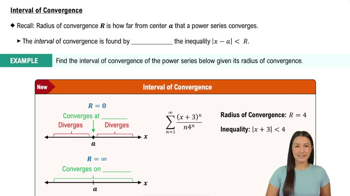
Interval of Convergence

Effect of Shifting the Center of a Power Series

Shifting the argument of a power series from f(x) to f(x - a) changes the center of the series from 0 to a. This means the new power series is centered at x = a, and the interval of convergence shifts accordingly, typically becoming |x - a| < R, preserving the radius of convergence.
Recommended video:
05:58
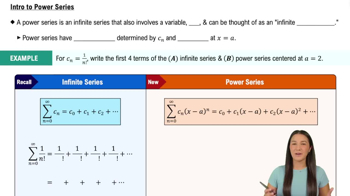
Intro to Power Series

Radius of Convergence and Its Invariance Under Translation

The radius of convergence R depends on the coefficients cₖ and remains unchanged when the series is shifted horizontally. Translation of the center does not affect R, only the center point changes, so the interval of convergence moves but retains the same radius.
Recommended video:
07:36
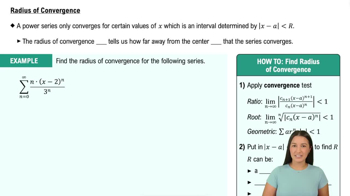
Radius of Convergence
Related Practice
Textbook Question

Functions to power series Find power series representations centered at 0 for the following functions using known power series. Give the interval of convergence for the resulting series.

f(x) = 2x/(1 + x²)²

78
views

Textbook Question

Functions to power series Find power series representations centered at 0 for the following functions using known power series. Give the interval of convergence for the resulting series.

f(x) = ln √(4 − x²)

60
views
Textbook Question

Exponential function In Section 11.3, we show that the power series for the exponential function centered at 0 is


eˣ = ∑ₖ₌₀∞ (xᵏ)/k!, for −∞ < x < ∞


Use the methods of this section to find the power series centered at 0 for the following functions. Give the interval of convergence for the resulting series.


f(x) = x²eˣ

81
views
Textbook Question

Radius and interval of convergence Determine the radius and interval of convergence of the following power series.


∑ₖ₌₁∞ sinᵏ(1/k) xᵏ

48
views
Textbook Question

{Use of Tech} Best center point Suppose you wish to approximate cos (π/ 2) using Taylor polynomials. Is the approximation more accurate if you use Taylor polynomials centered at 0 or at π/6? Use a calculator for numerical experiments and check for consistency with Theorem 11.2. Does the answer depend on the order of the polynomial?

48
views
Textbook Question

Radius and interval of convergence Determine the radius and interval of convergence of the following power series.


∑ₖ₌₁∞ (kx)ᵏ

70
views