
Textbook Question
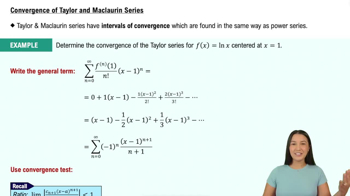
Sine integral function The function Si(x) = ∫₀ˣ f(t) dt, where f(t) = {(sin t)/t if t ≠ 0, 1 if t = 0, is called the sine integral function.
a. Expand the integrand in a Taylor series centered at 0.
121
views

 Verified step by step guidance
 08:26
08:26
 5:50
5:50 08:44
08:44Sine integral function The function Si(x) = ∫₀ˣ f(t) dt, where f(t) = {(sin t)/t if t ≠ 0, 1 if t = 0, is called the sine integral function.
a. Expand the integrand in a Taylor series centered at 0.
Probability: sudden−death playoff Teams A and B go into suddendeath overtime after playing to a tie. The teams alternate possession of the ball, and the first team to score wins. Assume each team has a 1/6 chance of scoring when it has the ball, and Team A has the ball first.
a. The probability that Team A ultimately wins is ∑ₖ₌₀∞ (1/6)(5/6)²ᵏ. Evaluate this series.
Taylor series
a. Use the definition of a Taylor series to find the first four nonzero terms of the Taylor series for the given function centered at a.
f(x) = 1/x, a = 1
Taylor series
a. Use the definition of a Taylor series to find the first four nonzero terms of the Taylor series for the given function centered at a.
f(x)=sin x, a = π/2
{Use of Tech} Bessel functions Bessel functions arise in the study of wave propagation in circular geometries (for example, waves on a circular drum head). They are conveniently defined as power series. One of an infinite family of Bessel functions is
J₀(x) = ∑ₖ₌₀∞ (−1)ᵏ/(2²ᵏ(k!)²) x²ᵏ
a. Write out the first four terms of J₀.
{Use of Tech} Fresnel integrals The theory of optics gives rise to the two Fresnel integrals
S(x) = ∫₀ˣ sin t² dt and C(x) = ∫₀ˣ cos t² dt
a. Compute S′(x) and C′(x).