
Textbook Question
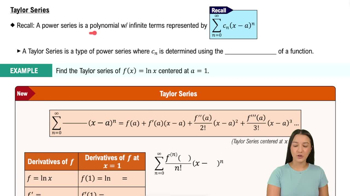
Find a Taylor series for f centered at 2 given that f⁽ᵏ⁾(2)=1, for all nonnegative integers k.
75
views

 Verified step by step guidance
 08:42
08:42
 06:35
06:35 06:00
06:00Find a Taylor series for f centered at 2 given that f⁽ᵏ⁾(2)=1, for all nonnegative integers k.
Use of Tech Linear and quadratic approximation
a. Find the linear approximating polynomial for the following functions centered at the given point a.
b. Find the quadratic approximating polynomial for the following functions centered at a.
c Use the polynomials obtained in parts (a) and (b) to approximate the given quantity.
f(x) = 8x^(3/2), a=1; approximate 8 ⋅ 1.1^(3/2)
{Use of Tech} Estimating errors Use the remainder to find a bound on the error in approximating the following quantities with the nth-order Taylor polynomial centered at 0. Estimates are not unique.
ln 1.04, n=3
{Use of Tech} Approximating definite integrals Use a Taylor series to approximate the following definite integrals. Retain as many terms as needed to ensure the error is less than 10⁻⁴.
∫₀⁰ᐧ² sin x² dx
Derivative trick Here is an alternative way to evaluate higher derivatives of a function f that may save time. Suppose you can find the Taylor series for f centered at the point a without evaluating derivatives (for example, from a known series). Then f⁽ᵏ⁾(a)=k! multiplied by the coefficient of (x−a)ᵏ. Use this idea to evaluate f⁽³⁾(0) and f⁽⁴⁾(0) for the following functions. Use known series and do not evaluate derivatives.
f(x) = eᶜᵒˢ ˣ
{Use of Tech} Approximating sin x Let f(x)=sin x, and let pₙ and qₙ be nth−order Taylor polynomials for f centered at 0 and π, respectively.
a. Find p₅ and q₅
b. Graph f, p₅, and q₅ on the interval [−π, 2π]. On what interval is p₅ a better approximation to f than q₅? On what interval is q₅ a better approximation to f than p₅?
c. Complete the following table showing the errors in the approximations given by p₅ and q₅ at selected points.
d. At which points in the table is p₅ a better approximation to f than q₅? At which points do p₅ and q₅ give equal approximations to f? Explain your observations.