
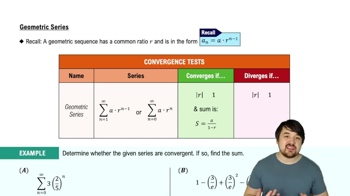
Radius and interval of convergence Use the Ratio Test or the Root Test to determine the radius of convergence of the following power series. Test the endpoints to determine the interval of convergence, when appropriate.
∞
Σ (x - 1)ᵏ/(k5ᵏ)
k = 1
Verified step by step guidance
Radius and interval of convergence Use the Ratio Test or the Root Test to determine the radius of convergence of the following power series. Test the endpoints to determine the interval of convergence, when appropriate.
∞
Σ (x - 1)ᵏ/(k5ᵏ)
k = 1
Matching functions with polynomials Match functions a–f with Taylor polynomials A–F (all centered at 0). Give reasons for your choices.
a. √(1 + 2x)
A. p₂(x)= 1 + 2x + 2x²
B. p₂(x) = 1 − 6x + 24x²
C. p₂(x) = 1 + x − x²/2
D. p₂(x) = 1 − 2x + 4x²
E. p₂(x) = 1 − x + (3/2)x²
F. p₂(x) = 1 − 2x + 2x²
Radius and interval of convergence Use the Ratio Test or the Root Test to determine the radius of convergence of the following power series. Test the endpoints to determine the interval of convergence, when appropriate.
∞
Σ (x/9)³ᵏ
k = 0
Taylor series and interval of convergence
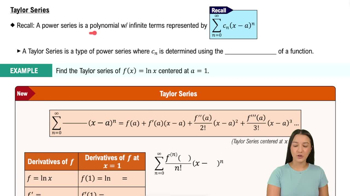
a. Use the definition of a Taylor/Maclaurin series to find the first four nonzero terms of the Taylor series for the given function centered at a.
f(x)=2/(1−x)³, a=0
Taylor series and interval of convergence
a. Use the definition of a Taylor/Maclaurin series to find the first four nonzero terms of the Taylor series for the given function centered at a.
f(x) = e⁻ˣ, a=0
ƒ(x) = eˣ, a = 0; e-0.08
a. Find the Taylor polynomials of order n = 1 and n = 2 for the given functions centered at the given point a.