
Ch. 11 - Power Series
Briggs - Calculus: Early Transcendentals 3rd Edition
Briggs3rd EditionCalculus: Early TranscendentalsISBN: 9780136847243Not the one you use?Change textbook
Chapter 11, Problem 11.4.4

Use the Taylor series for cos x centered at 0 to verify that lim ₓ→ₐ (1− cos x)/x = 0.

Verified step by step guidance
1
Recall the Taylor series expansion of \( \cos x \) centered at 0, which is given by: \[ \cos x = 1 - \frac{x^{2}}{2!} + \frac{x^{4}}{4!} - \frac{x^{6}}{6!} + \cdots \]
Substitute the Taylor series expansion of \( \cos x \) into the expression \( \frac{1 - \cos x}{x} \): \[ \frac{1 - \cos x}{x} = \frac{1 - \left(1 - \frac{x^{2}}{2!} + \frac{x^{4}}{4!} - \cdots \right)}{x} \]
Simplify the numerator by distributing the negative sign and combining like terms: \[ 1 - 1 + \frac{x^{2}}{2!} - \frac{x^{4}}{4!} + \cdots = \frac{x^{2}}{2!} - \frac{x^{4}}{4!} + \cdots \]
Rewrite the expression as: \[ \frac{\frac{x^{2}}{2!} - \frac{x^{4}}{4!} + \cdots}{x} = \frac{x^{2}}{2! \cdot x} - \frac{x^{4}}{4! \cdot x} + \cdots = \frac{x}{2!} - \frac{x^{3}}{4!} + \cdots \]
Now, analyze the limit as \( x \to 0 \): each term contains a factor of \( x \) or higher powers of \( x \), so all terms approach 0. Therefore, \[ \lim_{x \to 0} \frac{1 - \cos x}{x} = 0 \]

Verified video answer for a similar problem:

This video solution was recommended by our tutors as helpful for the problem above.
Video duration:
3m
Was this helpful?

Key Concepts

Here are the essential concepts you must grasp in order to answer the question correctly.

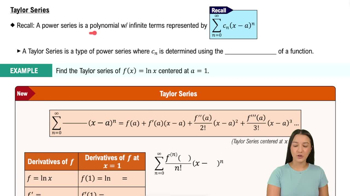
Taylor Series Expansion

The Taylor series expresses a function as an infinite sum of terms calculated from its derivatives at a single point. For cos x centered at 0, it expands as 1 - x²/2! + x⁴/4! - ..., which approximates cos x near zero and helps analyze limits involving cos x.
Recommended video:
08:42
Taylor Series

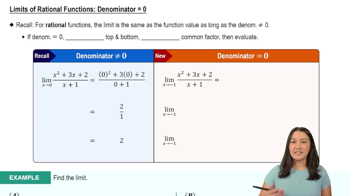
Limit of a Function as x Approaches a Point

A limit describes the value a function approaches as the input approaches a specific point. Evaluating limₓ→0 (1 - cos x)/x involves understanding how the numerator and denominator behave near zero to determine the limit's value.
Recommended video:
06:11
Limits of Rational Functions: Denominator = 0

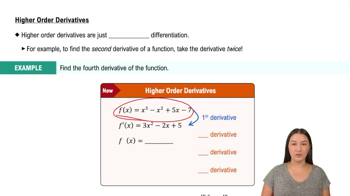
Behavior of Higher-Order Terms in Limits

When using series expansions in limits, higher-order terms (like x⁴ and beyond) become negligible as x approaches zero. Recognizing which terms dominate allows simplification of expressions to find the limit accurately.
Recommended video:
02:42
Higher Order Derivatives
Related Practice