Ch. 2 - Limits
Briggs - Calculus: Early Transcendentals 3rd Edition
Briggs3rd EditionCalculus: Early TranscendentalsISBN: 9780136847243Not the one you use?Change textbook
Chapter 2, Problem 2.7.43

Suppose limxa f(x)=L{\(\displaystyle\]\lim\)_{x\(\to\) a}}\(\text{ }\)f\(\left\)(x\(\right\))=L and limxa g(x)=M{\(\displaystyle\]\lim\)_{x\(\to\) a}}\(\text{ }\)g\(\left\)(x\(\right\))=M. Prove that limxa (f(x)g(x))=LM{\(\displaystyle\[\lim\)_{x\(\to\) a}}\(\text{ }\]\left\)(f\(\left\)(x\(\right\))-g\(\left\)(x\(\right\))\(\right\))=L-M.

Verified step by step guidance
1
Step 1: Start by recalling the limit properties. One important property is that the limit of a difference is the difference of the limits, provided the individual limits exist. This can be expressed as: if \( \lim_{x \to a} f(x) = L \) and \( \lim_{x \to a} g(x) = M \), then \( \lim_{x \to a} (f(x) - g(x)) = \lim_{x \to a} f(x) - \lim_{x \to a} g(x) \).
Step 2: Apply the limit property to the given functions \( f(x) \) and \( g(x) \). According to the problem, \( \lim_{x \to a} f(x) = L \) and \( \lim_{x \to a} g(x) = M \). Therefore, using the property, we have \( \lim_{x \to a} (f(x) - g(x)) = L - M \).
Step 3: Verify the conditions for applying the limit property. Ensure that both \( \lim_{x \to a} f(x) \) and \( \lim_{x \to a} g(x) \) exist and are finite, which is given in the problem statement.
Step 4: Conclude that since the conditions are satisfied and the property is applicable, the limit of the difference \( \lim_{x \to a} (f(x) - g(x)) \) is indeed \( L - M \).
Step 5: Summarize the proof by stating that the limit of the difference of two functions is equal to the difference of their limits, as demonstrated by applying the limit property to the given functions.

Verified video answer for a similar problem:

This video solution was recommended by our tutors as helpful for the problem above.
Video duration:
6m
Was this helpful?

Key Concepts

Here are the essential concepts you must grasp in order to answer the question correctly.

Limit of a Function

The limit of a function describes the behavior of that function as its input approaches a certain value. Formally, we say that the limit of f(x) as x approaches a is L if, for every small positive number ε, there exists a corresponding small positive number δ such that whenever 0 < |x - a| < δ, it follows that |f(x) - L| < ε. This concept is fundamental in calculus as it lays the groundwork for continuity and differentiability.
Recommended video:
06:11
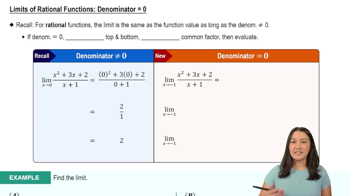
Limits of Rational Functions: Denominator = 0

Limit Properties

Limit properties are rules that allow us to compute limits of functions more easily. One important property is that the limit of the difference of two functions is the difference of their limits, provided both limits exist. This means that if lim(x→a) f(x) = L and lim(x→a) g(x) = M, then lim(x→a) (f(x) - g(x)) = L - M. Understanding these properties is crucial for proving statements about limits.
Recommended video:
06:21
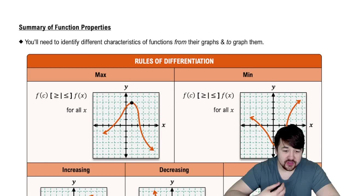
Properties of Functions

Proof Techniques in Calculus

Proof techniques in calculus involve logical reasoning to establish the validity of mathematical statements. Common methods include direct proof, proof by contradiction, and the epsilon-delta definition of limits. In the context of limits, one often uses these techniques to rigorously demonstrate that a limit exists or to derive relationships between limits, such as proving that the limit of a difference equals the difference of the limits.
Recommended video:
05:03
Initial Value Problems
Related Practice
Textbook Question

Use the precise definition of a limit to prove the following limits. Specify a relationship between ε and δ that guarantees the limit exists.

lim x→1 x^4=1

406
views

Textbook Question

b. Estimate a solution to the equation in the given interval using a root finder.


x^5+7x+5=0; (−1,0)

226
views
Textbook Question

Determine the interval(s) on which the following functions are continuous. 

f(x)=1 / x^2−4

320
views
Textbook Question

If a function f represents a system that varies in time, the existence of lim limtf(t){\(\displaystyle\[\lim\)_{t\(\rightarrow\]\infty\)}{f(t)}} means that the system reaches a steady state (or equilibrium). For the following systems, determine whether a steady state exists and give the steady-state value.


The population of a bacteria culture is given by p(t)=2500t+1p\(\left\)(t\(\right\))=\(\frac{2500}{t+1}\).

399
views
Textbook Question

A sequence is an infinite, ordered list of numbers that is often defined by a function. For example, the sequence {2,4,6,8,…} is specified by the function f(n) = 2n, where n=1,2,3,….The limit of such a sequence is lim n→∞ f(n), provided the limit exists. All the limit laws for limits at infinity may be applied to limits of sequences. Find the limit of the following sequences or state that the limit does not exist. 


{2,3/4,4/9,5/16,…}, which is defined by f(n) = (n+1) / n^2, for n=1,2,3,…

308
views
Textbook Question

Determine the points on the interval (0, 5) at which the following functions f have discontinuities. At each point of discontinuity, state the conditions in the continuity checklist that are violated. <IMAGE>

246
views