Ch. 3 - Derivatives
Briggs - Calculus: Early Transcendentals 3rd Edition
Briggs3rd EditionCalculus: Early TranscendentalsISBN: 9780136847243Not the one you use?Change textbook
Chapter 3, Problem 3.8.26b

13-26 Implicit differentiation Carry out the following steps.
b. Find the slope of the curve at the given point.
(x+y)^2/3=y; (4, 4)

Verified step by step guidance
1
Start by differentiating both sides of the equation \((x + y)^{2/3} = y\) with respect to \(x\). Remember that \(y\) is a function of \(x\), so you'll need to use implicit differentiation.
Apply the chain rule to differentiate the left side: \(\frac{d}{dx}((x + y)^{2/3}) = \frac{2}{3}(x + y)^{-1/3} \cdot (1 + \frac{dy}{dx})\).
Differentiate the right side with respect to \(x\): \(\frac{d}{dx}(y) = \frac{dy}{dx}\).
Set the derivatives equal to each other: \(\frac{2}{3}(x + y)^{-1/3} \cdot (1 + \frac{dy}{dx}) = \frac{dy}{dx}\).
Solve for \(\frac{dy}{dx}\) by isolating it on one side of the equation. Substitute \(x = 4\) and \(y = 4\) into the equation to find the slope of the curve at the point \((4, 4)\).

Verified video answer for a similar problem:

This video solution was recommended by our tutors as helpful for the problem above.
Video duration:
5m
Was this helpful?

Key Concepts

Here are the essential concepts you must grasp in order to answer the question correctly.

Implicit Differentiation

Implicit differentiation is a technique used to differentiate equations where the dependent and independent variables are not explicitly separated. Instead of solving for one variable in terms of the other, we differentiate both sides of the equation with respect to the independent variable, applying the chain rule as necessary. This method is particularly useful for curves defined by equations that cannot be easily rearranged.
Recommended video:
05:14
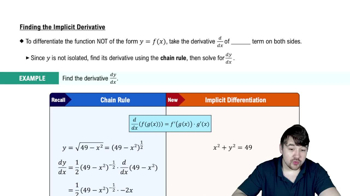
Finding The Implicit Derivative

Slope of a Curve

The slope of a curve at a given point represents the rate of change of the dependent variable with respect to the independent variable at that point. Mathematically, it is found by evaluating the derivative of the function at the specified coordinates. In the context of implicit differentiation, the slope can be determined by substituting the coordinates of the point into the derivative obtained from the implicit differentiation process.
Recommended video:
11:41
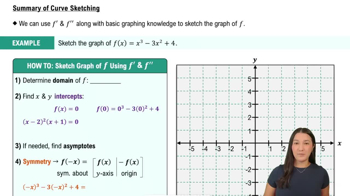
Summary of Curve Sketching

Chain Rule

The chain rule is a fundamental principle in calculus used to differentiate composite functions. It states that if a function is composed of two or more functions, the derivative of the outer function is multiplied by the derivative of the inner function. In implicit differentiation, the chain rule is applied when differentiating terms involving the dependent variable, ensuring that the derivative accounts for the relationship between the variables.
Recommended video:
05:02
Intro to the Chain Rule
Related Practice
Textbook Question

60–62. {Use of Tech} Multiple tangent lines Complete the following steps. <IMAGE>

b. Graph the tangent lines on the given graph.

x+y³−y=1; x=1

170
views

Textbook Question

13-26 Implicit differentiation Carry out the following steps.

b. Find the slope of the curve at the given point.

³√x+³√y⁴ = 2;(1,1)

194
views
Textbook Question

Explain why or why not Determine whether the following statements are true and give an explanation or counterexample.

b. d/dx(tan^−1 x) =sec² x

149
views
Textbook Question

A differential equation is an equation involving an unknown function and its derivatives. Consider the differential equation y′′(t)+y(t) = 0.

b. Show that y = B cos t satisfies the equation for any constant B.

254
views
Textbook Question

109-112 {Use of Tech} Calculating limits The following limits are the derivatives of a composite function g at a point a.

b. Use the Chain Rule to find each limit. Verify your answer by using a calculator.

limh013((1+h)5+7)1013(8)10h{\(\displaystyle\]\lim\)_{h\(\to\)0}}\(\frac{\frac{1}{3\left(\left(1+h\right)^5+7\right)^{10}\)}-\(\frac{1}{3\left(8\right)^{10}\)}}{h}

242
views
Textbook Question

{Use of Tech} A mixing tank A 500-liter (L) tank is filled with pure water. At time t=0, a salt solution begins flowing into the tank at a rate of 5 L/min. At the same time, the (fully mixed) solution flows out of the tank at a rate of 5.5 L/min. The mass of salt in grams in the tank at any time t≥0 is given by M(t) = 250(1000−t)(1−10−³⁰(1000−t)¹⁰) and the volume of solution in the tank is given by V(t) = 500-0.5t.

b. Graph the volume function and verify that the tank is empty when t=1000 min. 

275
views