
Ch. 3 - Derivatives
Briggs - Calculus: Early Transcendentals 3rd Edition
Briggs3rd EditionCalculus: Early TranscendentalsISBN: 9780136847243Not the one you use?Change textbook
Chapter 3, Problem 3.8.50a

45–50. Tangent lines Carry out the following steps. <IMAGE>
a. Verify that the given point lies on the curve.
(x²+y²)²=25/4 xy²; (1, 2)

Verified step by step guidance
1
First, substitute the given point (1, 2) into the equation of the curve \((x^2 + y^2)^2 = \frac{25}{4}xy^2\).
Calculate \(x^2 + y^2\) by substituting \(x = 1\) and \(y = 2\) into the expression, resulting in \(1^2 + 2^2 = 1 + 4 = 5\).
Substitute \(x = 1\) and \(y = 2\) into the right side of the equation \(\frac{25}{4}xy^2\), which becomes \(\frac{25}{4} \times 1 \times 2^2 = \frac{25}{4} \times 4 = 25\).
Now, substitute the calculated values into the original equation: \((5)^2 = 25\) and \(25 = 25\).
Since both sides of the equation are equal, the point (1, 2) lies on the curve.

Verified video answer for a similar problem:

This video solution was recommended by our tutors as helpful for the problem above.
Video duration:
2m
Was this helpful?

Key Concepts

Here are the essential concepts you must grasp in order to answer the question correctly.

Implicit Differentiation

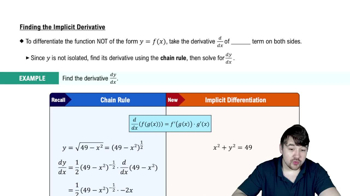
Implicit differentiation is a technique used to differentiate equations where the dependent and independent variables are not explicitly separated. In this case, we differentiate both sides of the equation (x² + y²)² = 25/4 xy² with respect to x, treating y as a function of x. This allows us to find the slope of the tangent line at a specific point on the curve.
Recommended video:
05:14
Finding The Implicit Derivative

Tangent Line

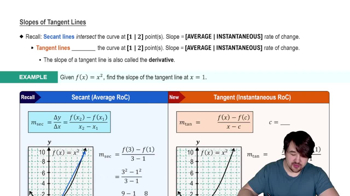
A tangent line to a curve at a given point is a straight line that touches the curve at that point and has the same slope as the curve at that point. The slope of the tangent line can be found using the derivative of the function at that point. The equation of the tangent line can then be expressed in point-slope form, using the coordinates of the point and the calculated slope.
Recommended video:
05:13
Slopes of Tangent Lines

Verifying Points on Curves

To verify that a point lies on a curve defined by an equation, we substitute the coordinates of the point into the equation. If the left-hand side equals the right-hand side after substitution, the point is confirmed to be on the curve. In this case, substituting (1, 2) into the equation (x² + y²)² = 25/4 xy² will determine if the point lies on the curve.
Recommended video:
11:41
Summary of Curve Sketching
Related Practice
Textbook Question

{Use of Tech} Angle of elevation A small plane, moving at 70 m/s, flies horizontally on a line 400 meters directly above an observer. Let θ be the angle of elevation of the plane (see figure). <IMAGE>


a. What is the rate of change of the angle of elevation dθ/dx when the plane is x=500 m past the observer?

169
views
Textbook Question

60–62. {Use of Tech} Multiple tangent lines Complete the following steps. <IMAGE>

a. Find equations of all lines tangent to the curve at the given value of x.

x+y³−y=1; x=1

259
views
Textbook Question

45–50. Tangent lines Carry out the following steps. <IMAGE>

a. Verify that the given point lies on the curve.

x⁴-x²y+y⁴=1; (−1, 1)

182
views
Textbook Question

{Use of Tech} Flow from a tank A cylindrical tank is full at time t=0 when a valve in the bottom of the tank is opened. By Torricelli’s law, the volume of water in the tank after t hours is V=100(200−t)², measured in cubic meters.

a. Graph the volume function. What is the volume of water in the tank before the valve is opened? 

227
views
Textbook Question

City urbanization City planners model the size of their city using the function A(t) = - 1/50t² + 2t +20, for 0 ≤ t ≤ 50, where A is measured in square miles and t is the number of years after 2010.

a. Compute A'(t). What units are associated with this derivative and what does the derivative measure?

383
views
Textbook Question

Use definition (2) (p. 135) to find the slope of the line tangent to the graph of f at P.

f(x) = x2 - 4; P(2, 0)

231
views