Ch. 3 - Derivatives
Briggs - Calculus: Early Transcendentals 3rd Edition
Briggs3rd EditionCalculus: Early TranscendentalsISBN: 9780136847243Not the one you use?Change textbook
Chapter 3, Problem 3.10.62b

62–65. {Use of Tech} Graphing f and f'
b. Compute and graph f'.
f(x) = (x−1) sin^−1 x on [−1,1]

Verified step by step guidance
1
First, understand the function f(x) = (x - 1) * sin^(-1)(x). This function is defined on the interval [-1, 1] because the inverse sine function, sin^(-1)(x), is only defined for x in [-1, 1].
To find the derivative f'(x), apply the product rule. The product rule states that if you have a function h(x) = u(x) * v(x), then h'(x) = u'(x) * v(x) + u(x) * v'(x). Here, let u(x) = x - 1 and v(x) = sin^(-1)(x).
Calculate the derivatives: u'(x) = 1 and v'(x) = 1 / sqrt(1 - x^2). The derivative of sin^(-1)(x) is 1 / sqrt(1 - x^2).
Apply the product rule: f'(x) = (x - 1) * (1 / sqrt(1 - x^2)) + 1 * sin^(-1)(x). Simplify this expression to get the final form of f'(x).
Use graphing technology to plot both f(x) and f'(x) on the interval [-1, 1]. Observe the behavior of the function and its derivative, noting any critical points or changes in concavity.

Verified video answer for a similar problem:

This video solution was recommended by our tutors as helpful for the problem above.
Video duration:
9m
Was this helpful?

Key Concepts

Here are the essential concepts you must grasp in order to answer the question correctly.

Derivative

The derivative of a function measures how the function's output value changes as its input value changes. It is defined as the limit of the average rate of change of the function over an interval as the interval approaches zero. In this context, computing the derivative f' of the function f(x) = (x−1) sin^−1 x will provide insights into the function's behavior, such as its increasing or decreasing nature.
Recommended video:
05:44
Derivatives

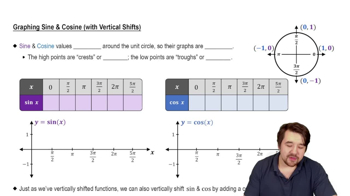
Graphing Functions

Graphing a function involves plotting its output values against its input values on a coordinate plane. For the function f(x) = (x−1) sin^−1 x, this means calculating f(x) for various x values within the interval [-1, 1] and representing these points visually. Understanding how to graph both f and its derivative f' helps in analyzing the function's characteristics, such as local maxima and minima.
Recommended video:
5:53
Graph of Sine and Cosine Function

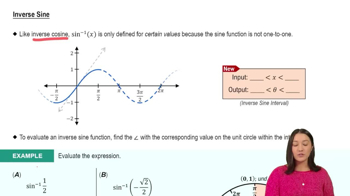
Inverse Sine Function

The inverse sine function, denoted as sin^−1 x or arcsin x, is the function that returns the angle whose sine is x. It is defined for x in the range [-1, 1], producing outputs in the range [-π/2, π/2]. In the given function f(x), the presence of sin^−1 x means that the behavior of f will be influenced by the properties of the inverse sine function, particularly its shape and limits within the specified interval.
Recommended video:
4:03
Inverse Sine