

Ch. 3 - Derivatives
Briggs - Calculus: Early Transcendentals 3rd Edition
Briggs3rd EditionCalculus: Early TranscendentalsISBN: 9780136847243Not the one you use?Change textbook
Chapter 3, Problem 3.10.65c

62–65. {Use of Tech} Graphing f and f'
c. Verify that the zeros of f' correspond to points at which f has a horizontal tangent line.
f(x)=e^−x tan^−1 x on [0,∞)

Verified step by step guidance
1
Step 1: Understand the problem. We need to graph the function f(x) = e^(-x) * tan^(-1)(x) and its derivative f'(x) over the interval [0, ∞). We will verify that the zeros of f'(x) correspond to points where f(x) has a horizontal tangent line.
Step 2: Find the derivative f'(x). Use the product rule for differentiation, which states that if you have a function h(x) = u(x) * v(x), then h'(x) = u'(x) * v(x) + u(x) * v'(x). Here, u(x) = e^(-x) and v(x) = tan^(-1)(x).
Step 3: Differentiate u(x) and v(x) separately. The derivative of u(x) = e^(-x) is u'(x) = -e^(-x). The derivative of v(x) = tan^(-1)(x) is v'(x) = 1/(1 + x^2).
Step 4: Apply the product rule. Substitute u(x), u'(x), v(x), and v'(x) into the product rule formula to find f'(x). This gives f'(x) = -e^(-x) * tan^(-1)(x) + e^(-x) * (1/(1 + x^2)).
Step 5: Graph f(x) and f'(x) using a graphing tool. Identify the zeros of f'(x) on the graph. These zeros are the x-values where f'(x) = 0, indicating that f(x) has a horizontal tangent line at these points. Verify that these correspond to the horizontal tangents on the graph of f(x).

Verified video answer for a similar problem:

This video solution was recommended by our tutors as helpful for the problem above.
Video duration:
7m
Was this helpful?

Key Concepts

Here are the essential concepts you must grasp in order to answer the question correctly.

Derivative and Critical Points

The derivative of a function, denoted as f', represents the rate of change of the function f. Critical points occur where the derivative is zero or undefined, indicating potential local maxima, minima, or points of inflection. In this context, finding the zeros of f' helps identify where the function f has horizontal tangent lines, which are essential for understanding the function's behavior.
Recommended video:
04:50
Critical Points

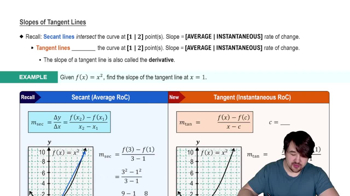
Horizontal Tangent Lines

A horizontal tangent line occurs at points on the graph of a function where the slope is zero, meaning the derivative f' equals zero. This indicates that the function is neither increasing nor decreasing at that point, which is crucial for identifying local extrema. Verifying that the zeros of f' correspond to horizontal tangents helps confirm the relationship between the derivative and the function's graphical behavior.
Recommended video:
05:13
Slopes of Tangent Lines

Graphing Functions

Graphing a function involves plotting its values on a coordinate system to visualize its behavior. For the function f(x) = e^(-x) tan^(-1)(x), understanding its graph helps in analyzing its critical points and the nature of its tangent lines. Technology can assist in graphing to easily identify where the function has horizontal tangents, enhancing comprehension of the relationship between f and f'.
Recommended video:
5:53
Graph of Sine and Cosine Function
Related Practice
Textbook Question

Highway travel A state patrol station is located on a straight north-south freeway. A patrol car leaves the station at 9:00 A.M. heading north with position function s = f(t) that gives its location in miles t hours after 9:00 A.M. (see figure). Assume s is positive when the car is north of the patrol station. <IMAGE>

c. Find the average velocity of the car over the interval [1.75, 2.25]. Estimate the velocity of the car at 11:00 A.M. and determine the direction in which the patrol car is moving.

239
views
Textbook Question

City urbanization City planners model the size of their city using the function A(t) = - 1/50t² + 2t +20, for 0 ≤ t ≤ 50, where A is measured in square miles and t is the number of years after 2010.

c. Suppose the population density of the city remains constant from year to year at 1000 people mi². Determine the growth rate of the population in 2030.

297
views
Textbook Question

Computing the derivative of f(x) = e^-x

c. Use parts (a) and (b) to find the derivative of f(x) = e^-x.

255
views
Textbook Question

62–65. {Use of Tech} Graphing f and f'

c. Verify that the zeros of f' correspond to points at which f has a horizontal tangent line.

f(x) = (x−1) sin^−1 x on [−1,1]

243
views
Textbook Question

Vertical tangent lines If a function f is continuous at a and lim x→a| f′(x)|=∞, then the curve y=f(x) has a vertical tangent line at a, and the equation of the tangent line is x=a. If a is an endpoint of a domain, then the appropriate one-sided derivative (Exercises 71–72) is used. Use this information to answer the following questions.

73. {Use of Tech} Graph the following functions and determine the location of the vertical tangent lines.

c. f(x) = √|x-4|

239
views
Textbook Question

97–100. Logistic growth Scientists often use the logistic growth function P(t) = P₀K / P₀+(K−P₀)e^−r₀t to model population growth, where P₀ is the initial population at time t=0, K is the carrying capacity, and r₀ is the base growth rate. The carrying capacity is a theoretical upper bound on the total population that the surrounding environment can support. The figure shows the sigmoid (S-shaped) curve associated with a typical logistic model. <IMAGE>


{Use of Tech} Gone fishing When a reservoir is created by a new dam, 50 fish are introduced into the reservoir, which has an estimated carrying capacity of 8000 fish. A logistic model of the fish population is P(t) = 400,000 / 50+7950e^−0.5t, where t is measured in years.


c. How fast (in fish per year) is the population growing at t=0? At t=5?

200
views