Ch. 3 - Derivatives
Briggs - Calculus: Early Transcendentals 3rd Edition
Briggs3rd EditionCalculus: Early TranscendentalsISBN: 9780136847243Not the one you use?Change textbook
Chapter 3, Problem 3.4.11a

7–14. Find the derivative the following ways:
a. Using the Product Rule (Exercises 7–10) or the Quotient Rule (Exercises 11–14). Simplify your result.
f(w) = w³ -w / w

Verified step by step guidance
1
Identify the function f(w) = \(\frac{w^3 - w}{w}\) and simplify it by dividing each term in the numerator by the denominator.
Simplify the expression: \(\frac{w^3}{w}\) - \(\frac{w}{w}\) = w^2 - 1.
Recognize that the simplified function f(w) = w^2 - 1 is a polynomial function.
Differentiate the simplified function using the power rule: \(\frac{d}{dw}\)(w^2) = 2w and \(\frac{d}{dw}\)(-1) = 0.
Combine the derivatives to find the derivative of the function: f'(w) = 2w.

Verified video answer for a similar problem:

This video solution was recommended by our tutors as helpful for the problem above.
Video duration:
4m
Was this helpful?

Key Concepts

Here are the essential concepts you must grasp in order to answer the question correctly.

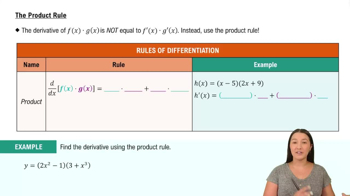
Product Rule

The Product Rule is a formula used to find the derivative of the product of two functions. If you have two functions, u(w) and v(w), the derivative of their product is given by u'v + uv'. This rule is essential when differentiating expressions where two functions are multiplied together, allowing for a systematic approach to finding the derivative.
Recommended video:
05:18
The Product Rule

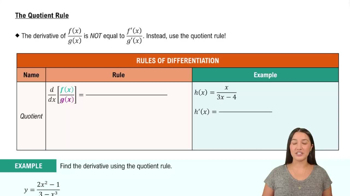
Quotient Rule

The Quotient Rule is used to differentiate functions that are expressed as the ratio of two other functions. If f(w) = u(w)/v(w), the derivative is given by (u'v - uv')/v². This rule is particularly useful when dealing with fractions in calculus, ensuring that the differentiation accounts for both the numerator and denominator.
Recommended video:
06:43
The Quotient Rule

Simplification of Derivatives

Simplification of derivatives involves reducing the expression obtained after applying differentiation rules to its simplest form. This may include factoring, canceling common terms, or combining like terms. Simplifying the result is crucial for clarity and ease of interpretation, especially when further analysis or evaluation is required.
Recommended video:
05:44
Derivatives
Related Practice
Textbook Question

45–50. Tangent lines Carry out the following steps. <IMAGE>

a. Verify that the given point lies on the curve.

x³+y³=2xy; (1, 1)

290
views

Textbook Question

Derivatives and tangent lines

a. For the following functions and values of a, find f′(a).

f(x) = √2x+1; a= 4

182
views
Textbook Question

Tracking a dive A biologist standing at the bottom of an 80-foot vertical cliff watches a peregrine falcon dive from the top of the cliff at a 45° angle from the horizontal (see figure). <IMAGE>


a. Express the angle of elevation θ from the biologist to the falcon as a function of the height h of the bird above the ground. (Hint: The vertical distance between the top of the cliff and the falcon is 80−h.)

266
views
Textbook Question

Airline travel The following figure shows the position function of an airliner on an out-and-back trip from Seattle to Minneapolis, where s = f(t) is the number of ground miles from Seattle t hours after take-off at 6:00 A.M. The plane returns to Seattle 8.5 hours later at 2:30 P.M. <IMAGE>

a. Calculate the average velocity of the airliner during the first 1.5 hours of the trip (0 ≤ t ≤ 1.5).

302
views
Textbook Question

Shrinking isosceles triangle The hypotenuse of an isosceles right triangle decreases in length at a rate of 4 m/s.

a. At what rate is the area of the triangle changing when the legs are 5 m long?

304
views
Textbook Question

13-26 Implicit differentiation Carry out the following steps.

a. Use implicit differentiation to find dy/dx.

sin y = 5x⁴−5; (1, π)

237
views