
Watching an elevator An observer is 20 m above the ground floor of a large hotel atrium looking at a glass-enclosed elevator shaft that is 20 m horizontally from the observer (see figure). The angle of elevation of the elevator is the angle that the observer’s line of sight makes with the horizontal (it may be positive or negative). Assuming the elevator rises at a rate of 5 m/s, what is the rate of change of the angle of elevation when the elevator is 10 m above the ground? When the elevator is 40 m above the ground? <IMAGE>
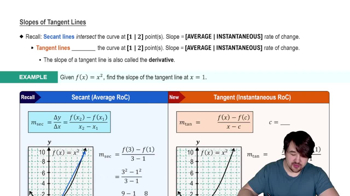
A line perpendicular to another line or to a tangent line is often called a normal line. Find an equation of the line perpendicular to the line that is tangent to the following curves at the given point P.
y= √x; P(4, 2)
Verified step by step guidance
Verified video answer for a similar problem:
Key Concepts
Tangent Line
Normal Line
Finding the Derivative
Find y'' for the following functions.
y = tan x
Find d/dx (In(xe^x)) without using the Chain Rule and the Product Rule.
Derivatives Find the derivative of the following functions. See Example 2 of Section 3.2 for the derivative of √x.
f(s) = √s/4
Matching heights A stone is thrown with an initial velocity of 32 ft/s from the edge of a bridge that is 48 ft above the ground. The height of this stone above the ground t seconds after it is thrown is f(t) = −16t²+32t+48 . If a second stone is thrown from the ground, then its height above the ground after t seconds is given by g(t) = −16t²+v0t, where v0 is the initial velocity of the second stone. Determine the value of v0 such that both stones reach the same high point.
Water is drained out of an inverted cone that has the same dimensions as the cone depicted in Exercise 36. If the water level drops at 1 ft/min, at what rate is water (in ft³/min) draining from the tank when the water depth is 6 ft?
