
A surface ship is moving (horizontally) in a straight line at 10 km/hr. At the same time, an enemy submarine maintains a position directly below the ship while diving at an angle that is 20° below the horizontal. How fast is the submarine’s altitude decreasing?
Ch. 3 - Derivatives
Briggs3rd EditionCalculus: Early TranscendentalsISBN: 9780136847243Not the one you use?Change textbook
Chapter 3, Problem 3.11.21
A spherical snowball melts at a rate proportional to its surface area. Show that the rate of change of the radius is constant. (Hint: Surface area=4πr².)
Verified step by step guidance1
Start by identifying the given information: the rate of change of the volume of the snowball is proportional to its surface area. The surface area of a sphere is given by \( A = 4\pi r^2 \).
Express the volume \( V \) of the sphere in terms of its radius \( r \) using the formula \( V = \frac{4}{3}\pi r^3 \).
Differentiate the volume \( V \) with respect to time \( t \) to find \( \frac{dV}{dt} \). Using the chain rule, \( \frac{dV}{dt} = 4\pi r^2 \frac{dr}{dt} \).
Since the rate of change of the volume is proportional to the surface area, we have \( \frac{dV}{dt} = k \cdot 4\pi r^2 \), where \( k \) is a constant of proportionality.
Equate the two expressions for \( \frac{dV}{dt} \): \( 4\pi r^2 \frac{dr}{dt} = k \cdot 4\pi r^2 \). Simplify to find \( \frac{dr}{dt} = k \), showing that the rate of change of the radius is constant.

Verified video answer for a similar problem:
This video solution was recommended by our tutors as helpful for the problem above.
Video duration:
4mWas this helpful?
Key Concepts
Here are the essential concepts you must grasp in order to answer the question correctly.
Surface Area of a Sphere
The surface area of a sphere is given by the formula A = 4πr², where r is the radius. This formula indicates that the surface area increases with the square of the radius. Understanding this relationship is crucial because the problem states that the rate of melting is proportional to this surface area, linking the geometry of the sphere to its rate of change.
Recommended video:
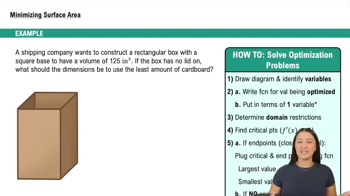
Example 1: Minimizing Surface Area
Rate of Change
In calculus, the rate of change refers to how a quantity changes in relation to another variable. In this context, we are interested in how the radius of the snowball changes over time as it melts. By establishing a relationship between the surface area and the radius, we can derive the rate of change of the radius with respect to time.
Recommended video:
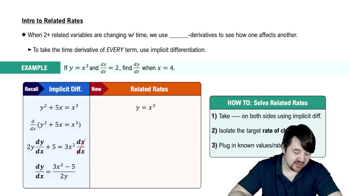
Intro To Related Rates
Proportional Relationships
A proportional relationship means that one quantity changes at a constant rate relative to another. In this scenario, the rate at which the snowball melts is proportional to its surface area. This implies that as the surface area decreases, the radius will also change at a consistent rate, leading to the conclusion that the rate of change of the radius remains constant.
Recommended video:
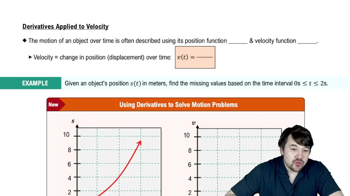
Derivatives Applied To Velocity
Related Practice
Textbook Question
292
views
Textbook Question
15–48. Derivatives Find the derivative of the following functions.
y = In (x³+1)^π
366
views
Textbook Question
Find the derivative of the following functions.
y = x sin x
331
views
Textbook Question
47–56. Derivatives of inverse functions at a point Consider the following functions. In each case, without finding the inverse, evaluate the derivative of the inverse at the given point.
f(x)=4e^10x; (4,0)
182
views
Textbook Question
Derivatives Find the derivative of the following functions. See Example 2 of Section 3.2 for the derivative of √x.
f(v) = v¹⁰⁰+e^v+10
277
views
Textbook Question
23–51. Calculating derivatives Find the derivative of the following functions.
y = a sin x + b cos x/a sin x - b cos x; a and b are nonzero constants
309
views
