Ch. 3 - Derivatives
Briggs - Calculus: Early Transcendentals 3rd Edition
Briggs3rd EditionCalculus: Early TranscendentalsISBN: 9780136847243Not the one you use?Change textbook
Chapter 3, Problem 3.9.65

Calculate the derivative of the following functions. In some cases, it is useful to use the properties of logarithms to simplify the functions before computing f'(x).


y = (cos x) In cos²x

Verified step by step guidance
1
First, identify the function y = (cos x) ln(cos²x). Notice that it is a product of two functions: u(x) = cos(x) and v(x) = ln(cos²x).
Apply the product rule for derivatives, which states that if y = u(x) * v(x), then y' = u'(x) * v(x) + u(x) * v'(x).
Calculate the derivative of u(x) = cos(x). The derivative u'(x) is -sin(x).
Simplify v(x) = ln(cos²x) using the properties of logarithms: ln(cos²x) = 2 ln(cos(x)). Now, find the derivative v'(x). The derivative of ln(cos(x)) is -tan(x), so v'(x) = 2(-tan(x)) = -2tan(x).
Substitute u'(x), v(x), u(x), and v'(x) into the product rule formula: y' = (-sin(x)) * ln(cos²x) + cos(x) * (-2tan(x)). Simplify the expression to find the derivative.

Verified video answer for a similar problem:

This video solution was recommended by our tutors as helpful for the problem above.
Video duration:
6m
Was this helpful?

Key Concepts

Here are the essential concepts you must grasp in order to answer the question correctly.

Derivative

The derivative of a function measures how the function's output value changes as its input value changes. It is a fundamental concept in calculus, representing the slope of the tangent line to the curve of the function at any given point. The derivative is denoted as f'(x) or dy/dx and can be calculated using various rules, such as the product rule, quotient rule, and chain rule.
Recommended video:
05:44
Derivatives

Logarithmic Properties

Logarithmic properties are rules that simplify the manipulation of logarithmic expressions. Key properties include the product rule (log(a*b) = log(a) + log(b)), the quotient rule (log(a/b) = log(a) - log(b)), and the power rule (log(a^b) = b*log(a)). These properties are particularly useful in calculus for simplifying complex functions before differentiation, making it easier to compute derivatives.
Recommended video:
05:36
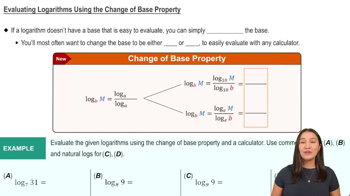
Change of Base Property

Chain Rule

The chain rule is a fundamental technique in calculus used to differentiate composite functions. It states that if a function y = f(g(x)) is composed of two functions, the derivative can be found by multiplying the derivative of the outer function f with the derivative of the inner function g. This rule is essential when dealing with functions that are nested within each other, allowing for the correct application of differentiation.
Recommended video:
05:02
Intro to the Chain Rule
Related Practice
Textbook Question

75–86. Logarithmic differentiation Use logarithmic differentiation to evaluate f'(x).

f(x) = x^In x

189
views

Textbook Question

At all times, the length of the long leg of a right triangle is 3 times the length x of the short leg of the triangle. If the area of the triangle changes with respect to time t, find equations relating the area A to x and dA/dt to dx/dt.

281
views
Textbook Question

{Use of Tech} Difference quotients Suppose f is differentiable for all x and consider the function D(x) = f(x+0.01)-f(x) / 0.01 For the following functions, graph D on the given interval, and explain why the graph appears as it does. What is the relationship between the functions f and D?

f(x) = sin x on [−π,π]

268
views
Textbook Question

47–56. Derivatives of inverse functions at a point Consider the following functions. In each case, without finding the inverse, evaluate the derivative of the inverse at the given point.

f(x)=tan x; (1,π/4)

148
views
Textbook Question

Derivatives of products and quotients Find the derivative of the following functions by first expanding or simplifying the expression. Simplify your answers. 

h(x) = √x (√x-x³/²)

220
views
Textbook Question

A projectile is fired vertically upward into the air; its position (in feet) above the ground after t seconds is given by the function s (t). For the following functions, use limits to determine the instantaneous velocity of the projectile at t = a seconds for the given value of a.

s(t) = -16t2 + 128t + 192; a = 2

274
views