Ch. 3 - Derivatives
Briggs - Calculus: Early Transcendentals 3rd Edition
Briggs3rd EditionCalculus: Early TranscendentalsISBN: 9780136847243Not the one you use?Change textbook
Chapter 3, Problem 3.33a

Derivatives and tangent lines
a. For the following functions and values of a, find f′(a).
f(x) = 8x; a = −3

Verified step by step guidance
1
Step 1: Identify the function f(x) = 8x and the point a = -3 where you need to find the derivative.
Step 2: Recall that the derivative of a linear function f(x) = mx is f'(x) = m. In this case, m = 8.
Step 3: Since the derivative of f(x) = 8x is constant, f'(x) = 8 for all x.
Step 4: Evaluate the derivative at the given point a = -3. Since f'(x) = 8 for all x, f'(-3) = 8.
Step 5: Conclude that the derivative of the function at the point a = -3 is f'(-3) = 8.

Verified video answer for a similar problem:

This video solution was recommended by our tutors as helpful for the problem above.
Video duration:
2m
Was this helpful?

Key Concepts

Here are the essential concepts you must grasp in order to answer the question correctly.

Derivatives

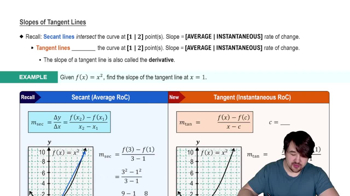
A derivative represents the rate of change of a function with respect to its variable. It is defined as the limit of the average rate of change of the function as the interval approaches zero. In practical terms, the derivative at a point gives the slope of the tangent line to the function at that point.
Recommended video:
05:44
Derivatives

Tangent Lines

A tangent line to a curve at a given point is a straight line that touches the curve at that point without crossing it. The slope of the tangent line is equal to the derivative of the function at that point. This concept is crucial for understanding how functions behave locally around specific values.
Recommended video:
05:13
Slopes of Tangent Lines

Function Evaluation

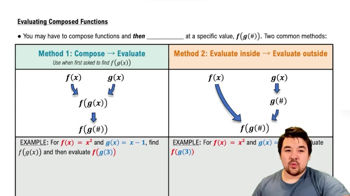
Function evaluation involves substituting a specific value into a function to determine its output. In the context of derivatives, evaluating the function at a point helps in calculating the derivative at that point. For example, in the function f(x) = 8x, evaluating at a = -3 allows us to find the slope of the tangent line at that specific x-value.
Recommended video:
4:26
Evaluating Composed Functions
Related Practice
Textbook Question

Use definition (1) (p. 133) to find the slope of the line tangent to the graph of f at P.

f(x) = -3x2 - 5x + 1; P(1,-7)

218
views

Textbook Question

{Use of Tech} Angle of elevation A small plane, moving at 70 m/s, flies horizontally on a line 400 meters directly above an observer. Let θ be the angle of elevation of the plane (see figure). <IMAGE>


a. What is the rate of change of the angle of elevation dθ/dx when the plane is x=500 m past the observer?

169
views
Textbook Question

Derivatives using tables Let h(x)=f(g(x))h(x)=f(g(x)) and p(x)=g(f(x))p(x)=g(f(x)). Use the table to compute the following derivatives.

<IMAGE>

a. h(3)h^{\(\prime\)}\(\left\)(3\(\right\))

284
views
Textbook Question

60–62. {Use of Tech} Multiple tangent lines Complete the following steps. <IMAGE>

a. Find equations of all lines tangent to the curve at the given value of x.

x+y³−y=1; x=1

259
views
Textbook Question

{Use of Tech} Spring oscillations A spring hangs from the ceiling at equilibrium with a mass attached to its end. Suppose you pull downward on the mass and release it 10 inches below its equilibrium position with an upward push. The distance x (in inches) of the mass from its equilibrium position after t seconds is given by the function x(t) = 10sin t - 10cos t, where x is positive when the mass is above the equilibrium position. <IMAGE>

b. Find dx/dt and interpret the meaning of this derivative.  

208
views
Textbook Question

21–30. Derivatives

b. Evaluate f'(a) for the given values of a.

f(x) = 1/x+1; a = -1/2;5

317
views