Ch. 3 - Derivatives
Briggs - Calculus: Early Transcendentals 3rd Edition
Briggs3rd EditionCalculus: Early TranscendentalsISBN: 9780136847243Not the one you use?Change textbook
Chapter 3, Problem 3.40b

Derivatives and tangent lines
b. Determine an equation of the line tangent to the graph of f at the point (a,f(a)) for the given value of a.
f(x) = √3x; a= 12

Verified step by step guidance
1
Step 1: Identify the function and the point of tangency. The function given is \( f(x) = \sqrt{3x} \) and the point of tangency is \( (a, f(a)) \) where \( a = 12 \).
Step 2: Calculate \( f(a) \). Substitute \( a = 12 \) into the function to find \( f(12) = \sqrt{3 \times 12} \).
Step 3: Find the derivative of the function \( f(x) = \sqrt{3x} \). Use the chain rule: \( f'(x) = \frac{d}{dx}(3x)^{1/2} = \frac{1}{2}(3x)^{-1/2} \cdot 3 \).
Step 4: Evaluate the derivative at \( x = 12 \). Substitute \( x = 12 \) into \( f'(x) \) to find \( f'(12) \).
Step 5: Use the point-slope form of a line to write the equation of the tangent line. The formula is \( y - f(a) = f'(a)(x - a) \). Substitute \( f(12) \) and \( f'(12) \) into this equation.

Verified video answer for a similar problem:

This video solution was recommended by our tutors as helpful for the problem above.
Video duration:
6m
Was this helpful?

Key Concepts

Here are the essential concepts you must grasp in order to answer the question correctly.

Derivative

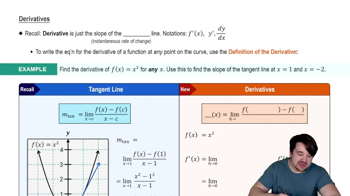
The derivative of a function at a point measures the rate at which the function's value changes as its input changes. It is defined as the limit of the average rate of change of the function over an interval as the interval approaches zero. In practical terms, the derivative at a point gives the slope of the tangent line to the graph of the function at that point.
Recommended video:
05:44
Derivatives

Tangent Line

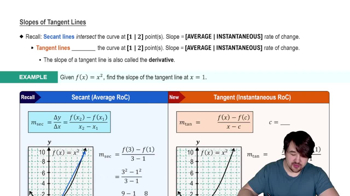
A tangent line to a curve at a given point is a straight line that touches the curve at that point without crossing it. The slope of the tangent line is equal to the derivative of the function at that point. The equation of the tangent line can be expressed in point-slope form, which is derived from the slope and the coordinates of the point of tangency.
Recommended video:
05:13
Slopes of Tangent Lines

Point-Slope Form

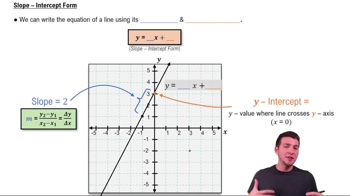
The point-slope form of a linear equation is given by y - y₁ = m(x - x₁), where (x₁, y₁) is a point on the line and m is the slope. This form is particularly useful for writing the equation of a tangent line once the slope (derivative) and the point of tangency are known. By substituting the appropriate values, one can easily derive the equation of the tangent line.
Recommended video:
Guided course
3:56
Slope-Intercept Form
Related Practice
Textbook Question

13-26 Implicit differentiation Carry out the following steps.

b. Find the slope of the curve at the given point.

tan xy = x+y; (0,0)

184
views

Textbook Question

Derivatives using tables Let h(x)=f(g(x))h(x)=f(g(x)) and p(x)=g(f(x))p(x)=g(f(x)). Use the table to compute the following derivatives.

<IMAGE>

b. h(2)h^{\(\prime\)}\(\left\)(2\(\right\))

278
views
Textbook Question

13-26 Implicit differentiation Carry out the following steps.

b. Find the slope of the curve at the given point.

³√x+³√y⁴ = 2;(1,1)

194
views
Textbook Question

Explain why or why not Determine whether the following statements are true and give an explanation or counterexample.

b. d/dx(tan^−1 x) =sec² x

149
views
Textbook Question

The energy (in joules) released by an earthquake of magnitude M is given by the equation E=25,000 ⋅ 101.5M. (This equation can be solved for M to define the magnitude of a given earthquake; it is a refinement of the original Richter scale created by Charles Richter in 1935.)

Compute dE/dM and evaluate it for M=3. What does this derivative mean? (M has no units, so the units of the derivative are J per change in magnitude.)

267
views
Textbook Question

{Use of Tech} A mixing tank A 500-liter (L) tank is filled with pure water. At time t=0, a salt solution begins flowing into the tank at a rate of 5 L/min. At the same time, the (fully mixed) solution flows out of the tank at a rate of 5.5 L/min. The mass of salt in grams in the tank at any time t≥0 is given by M(t) = 250(1000−t)(1−10−³⁰(1000−t)¹⁰) and the volume of solution in the tank is given by V(t) = 500-0.5t.

b. Graph the volume function and verify that the tank is empty when t=1000 min. 

275
views