
Ch. 3 - Derivatives
Briggs - Calculus: Early Transcendentals 3rd Edition
Briggs3rd EditionCalculus: Early TranscendentalsISBN: 9780136847243Not the one you use?Change textbook
Chapter 3, Problem 3.7.25c

Derivatives using tables Let h(x)=f(g(x))h(x)=f(g(x)) and p(x)=g(f(x))p(x)=g(f(x)). Use the table to compute the following derivatives.
<IMAGE>
c. p(4)p^{\(\prime\)}\(\left\)(4\(\right\))

Verified step by step guidance
1
Identify the function composition for p(x) = g(f(x)). We need to find the derivative p'(x) using the chain rule.
Apply the chain rule for derivatives: If p(x) = g(f(x)), then p'(x) = g'(f(x)) * f'(x).
Evaluate f(x) at x = 4 to find f(4). Use the table to find the value of f(4).
Use the table to find f'(4), the derivative of f at x = 4.
Substitute f(4) into g'(f(x)) to find g'(f(4)) using the table, then multiply g'(f(4)) by f'(4) to find p'(4).

Verified video answer for a similar problem:

This video solution was recommended by our tutors as helpful for the problem above.
Video duration:
2m
Was this helpful?

Key Concepts

Here are the essential concepts you must grasp in order to answer the question correctly.

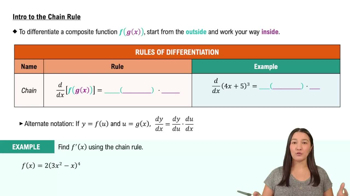
Chain Rule

The Chain Rule is a fundamental theorem in calculus used to differentiate composite functions. It states that if a function h(x) is composed of two functions f and g, such that h(x) = f(g(x)), then the derivative h'(x) can be found using the formula h'(x) = f'(g(x)) * g'(x). This rule is essential for calculating derivatives of functions that are nested within each other.
Recommended video:
05:02
Intro to the Chain Rule

Derivative Notation

Derivative notation, such as f'(x) or p'(4), represents the rate of change of a function at a specific point. The notation p'(4) indicates the derivative of the function p(x) evaluated at x = 4. Understanding this notation is crucial for interpreting the results of differentiation and applying them to specific values.
Recommended video:
04:22
Sigma Notation

Function Evaluation

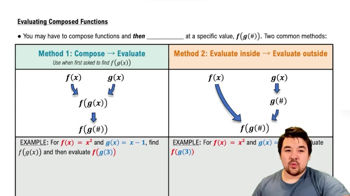
Function evaluation involves substituting a specific value into a function to determine its output. For example, evaluating p(4) means substituting 4 into the function p(x) to find its value. This concept is important when calculating derivatives, as it often requires evaluating the original functions at certain points to find the necessary derivatives for applying the Chain Rule.
Recommended video:
4:26
Evaluating Composed Functions
Related Practice
Textbook Question

97–100. Logistic growth Scientists often use the logistic growth function P(t) = P₀K / P₀+(K−P₀)e^−r₀t to model population growth, where P₀ is the initial population at time t=0, K is the carrying capacity, and r₀ is the base growth rate. The carrying capacity is a theoretical upper bound on the total population that the surrounding environment can support. The figure shows the sigmoid (S-shaped) curve associated with a typical logistic model. <IMAGE>


{Use of Tech} Gone fishing When a reservoir is created by a new dam, 50 fish are introduced into the reservoir, which has an estimated carrying capacity of 8000 fish. A logistic model of the fish population is P(t) = 400,000 / 50+7950e^−0.5t, where t is measured in years.


d. Graph P' and use the graph to estimate the year in which the population is growing fastest. 

235
views
Textbook Question

62–65. {Use of Tech} Graphing f and f'

c. Verify that the zeros of f' correspond to points at which f has a horizontal tangent line.

f(x)=(x²−1)sin^−1 x on [−1,1]

150
views
Textbook Question

Derivatives of inverse functions from a table Use the following tables to determine the indicated derivatives or state that the derivative cannot be determined. <IMAGE>

d. f'(1)

215
views
Textbook Question

Throwing a stone Suppose a stone is thrown vertically upward from the edge of a cliff on Earth with an initial velocity of 32 ft/s from a height of 48 ft above the ground. The height (in feet) of the stone above the ground t seconds after it is thrown is s(t) = -16t²+32t+48.

c. What is the height of the stone at the highest point?

234
views
Textbook Question

A rectangular swimming pool 10 ft wide by 20 ft long and of uniform depth is being filled with water.

c. At what rate is the water level rising if the pool is filled at a rate of 10ft³/min?

215
views
Textbook Question

Derivatives using tables Let h(x)=f(g(x))h(x)=f(g(x)) and p(x)=g(f(x))p(x)=g(f(x)). Use the table to compute the following derivatives.

<IMAGE>

d. p(2)p^{\(\prime\)}\(\left\)(2\(\right\))

233
views