Ch. 3 - Derivatives
Briggs - Calculus: Early Transcendentals 3rd Edition
Briggs3rd EditionCalculus: Early TranscendentalsISBN: 9780136847243Not the one you use?Change textbook
Chapter 3, Problem 99a

Product Rule for three functions Assume f, g, and h are differentiable at x.
a. Use the Product Rule (twice) to find a formula for d/dx (f(x)g(x)h(x)).

Verified step by step guidance
1
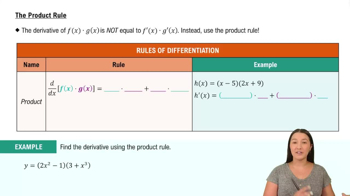
Step 1: Recall the Product Rule for two functions, which states that if u(x) and v(x) are differentiable functions, then the derivative of their product is given by \( \frac{d}{dx}[u(x)v(x)] = u'(x)v(x) + u(x)v'(x) \).
Step 2: To find the derivative of the product of three functions \( f(x)g(x)h(x) \), first consider \( u(x) = f(x) \) and \( v(x) = g(x)h(x) \). Apply the Product Rule to these two functions.
Step 3: Differentiate \( v(x) = g(x)h(x) \) using the Product Rule again. Let \( u(x) = g(x) \) and \( v(x) = h(x) \), so \( \frac{d}{dx}[g(x)h(x)] = g'(x)h(x) + g(x)h'(x) \).
Step 4: Substitute the result from Step 3 into the expression obtained in Step 2. This gives \( \frac{d}{dx}[f(x)g(x)h(x)] = f'(x)g(x)h(x) + f(x)(g'(x)h(x) + g(x)h'(x)) \).
Step 5: Simplify the expression from Step 4 to obtain the final formula: \( \frac{d}{dx}[f(x)g(x)h(x)] = f'(x)g(x)h(x) + f(x)g'(x)h(x) + f(x)g(x)h'(x) \).

Verified video answer for a similar problem:

This video solution was recommended by our tutors as helpful for the problem above.
Video duration:
9m
Was this helpful?

Key Concepts

Here are the essential concepts you must grasp in order to answer the question correctly.

Product Rule

The Product Rule is a fundamental principle in calculus used to differentiate products of functions. It states that if you have two differentiable functions, f(x) and g(x), the derivative of their product is given by d/dx [f(x)g(x)] = f'(x)g(x) + f(x)g'(x). This rule can be extended to more than two functions, allowing for the differentiation of products involving three or more functions.
Recommended video:
05:18
The Product Rule

Differentiability

A function is said to be differentiable at a point if it has a defined derivative at that point, meaning it has a tangent line that is not vertical. Differentiability implies continuity, but not vice versa. For the Product Rule to apply, all functions involved must be differentiable at the point of interest, ensuring that their derivatives can be computed and combined appropriately.
Recommended video:
05:53
Finding Differentials

Chain of Derivatives

When applying the Product Rule to multiple functions, it is essential to understand how to manage the derivatives of each function in the product. For three functions, f(x), g(x), and h(x), the derivative is found by applying the Product Rule iteratively. This involves taking the derivative of one function while keeping the others constant, and then summing the results, which requires careful organization of terms to ensure all combinations are accounted for.
Recommended video:
05:02
Intro to the Chain Rule
Related Practice
Textbook Question

Composition containing sin x Suppose f is differentiable on [−2,2] with f′(0)=3 and f′(1)=5. Let g(x)=f(sin x). Evaluate the following expressions.

c. g'(π)

363
views

Textbook Question

The population of the United States (in millions) by decade is given in the table, where t is the number of years after 1910. These data are plotted and fitted with a smooth curve y = p(t) in the figure. <IMAGE><IMAGE>

Estimate the instantaneous rate of growth in 1985. 

156
views
Textbook Question

Use the definition of the derivative to evaluate the following limits.

limh0ln(e8+h)8h\(\lim\)_{h\(\to\)0}\(\frac{\ln\left(e^8+h\right)-8}{h}\)_{}

258
views
Textbook Question

The population of the United States (in millions) by decade is given in the table, where t is the number of years after 1910. These data are plotted and fitted with a smooth curve y = p(t) in the figure. <IMAGE><IMAGE>

Explain why the average rate of growth from 1950 to 1960 is a good approximation to the (instantaneous) rate of growth in 1955.

173
views
Textbook Question

{Use of Tech} Beak length The length of the culmen (the upper ridge of a bird’s bill) of a t-week-old Indian spotted owlet is modeled by the function L(t)=11.94 / 1 + 4e^−1.65t, where L is measured in millimeters.


a. Find L′(1) and interpret the meaning of this value.

278
views
Textbook Question

Composition containing sin x Suppose f is differentiable for all real numbers with f(0)=−3,f(1)=3,f′(0)=3, and f′(1)=5. Let g(x)=sin(πf(x)). Evaluate the following expressions.

b. g'(1)

357
views