Ch. 3 - Derivatives
Briggs - Calculus: Early Transcendentals 3rd Edition
Briggs3rd EditionCalculus: Early TranscendentalsISBN: 9780136847243Not the one you use?Change textbook
Chapter 3, Problem 3.1.26a

Use definition (2) (p. 135) to find the slope of the line tangent to the graph of f at P.
f(x) = 1/x; P (1,1)

Verified step by step guidance
1
Step 1: Recall the definition of the derivative as the slope of the tangent line at a point. The derivative of a function f at a point x = a is given by the limit: \( f'(a) = \lim_{h \to 0} \frac{f(a+h) - f(a)}{h} \).
Step 2: Identify the function and the point of interest. Here, the function is \( f(x) = \frac{1}{x} \) and the point P is (1, 1). We need to find \( f'(1) \).
Step 3: Substitute \( f(x) = \frac{1}{x} \) into the derivative formula. This gives: \( f'(1) = \lim_{h \to 0} \frac{f(1+h) - f(1)}{h} = \lim_{h \to 0} \frac{\frac{1}{1+h} - 1}{h} \).
Step 4: Simplify the expression inside the limit. Start by finding a common denominator for the terms in the numerator: \( \frac{1}{1+h} - 1 = \frac{1 - (1+h)}{1+h} = \frac{-h}{1+h} \).
Step 5: Substitute the simplified expression back into the limit: \( f'(1) = \lim_{h \to 0} \frac{-h}{h(1+h)} \). Simplify this to \( \lim_{h \to 0} \frac{-1}{1+h} \) and evaluate the limit as \( h \to 0 \).

Verified video answer for a similar problem:

This video solution was recommended by our tutors as helpful for the problem above.
Video duration:
3m
Was this helpful?

Key Concepts

Here are the essential concepts you must grasp in order to answer the question correctly.

Tangent Line

A tangent line to a curve at a given point is a straight line that touches the curve at that point without crossing it. The slope of the tangent line represents the instantaneous rate of change of the function at that point, which is crucial for understanding how the function behaves locally.
Recommended video:
05:13
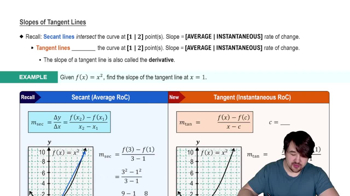
Slopes of Tangent Lines

Derivative

The derivative of a function at a point quantifies how the function's output changes as its input changes. It is defined as the limit of the average rate of change of the function as the interval approaches zero. For the function f(x) = 1/x, finding the derivative will provide the slope of the tangent line at point P.
Recommended video:
05:44
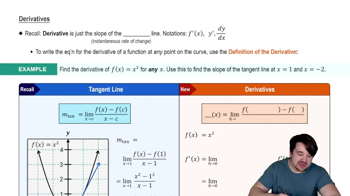
Derivatives

Limit Definition of Derivative

The limit definition of the derivative states that the derivative f'(a) at a point a is the limit of the difference quotient as h approaches zero: f'(a) = lim (h -> 0) [(f(a+h) - f(a))/h]. This definition is fundamental for calculating the slope of the tangent line, as it provides a precise method to determine the instantaneous rate of change at a specific point.
Recommended video:
05:43
Definition of the Definite Integral
Related Practice
Textbook Question

{Use of Tech} A damped oscillator The displacement of a mass on a spring suspended from the ceiling is given by y=10et2cos(πt8)y=10e^{-\(\frac{t}{2}\)}\(\cos\[\left\)(\(\frac{\pi t}{8}\]\right\)).

a. Graph the displacement function. 

285
views

Textbook Question

62–65. {Use of Tech} Graphing f and f'

a. Graph f with a graphing utility.

f(x) = (x−1) sin^−1 x on [−1,1]

221
views
Textbook Question

31–32. Velocity functions A projectile is fired vertically upward into the air, and its position (in feet) above the ground after t seconds is given by the function s(t).

a. For the following functions s(t), find the instantaneous velocity function v(t). (Recall that the velocity function v is the derivative of the position function s.)

s(t)= −16t²+100t

244
views
Textbook Question

Use definition (2) (p. 135) to find the slope of the line tangent to the graph of f at P.

f(x) = -7x; P(-1,7)

200
views
Textbook Question

Vertical tangent lines If a function f is continuous at a and lim x→a| f′(x)|=∞, then the curve y=f(x) has a vertical tangent line at a, and the equation of the tangent line is x=a. If a is an endpoint of a domain, then the appropriate one-sided derivative (Exercises 71–72) is used. Use this information to answer the following questions.

73. {Use of Tech} Graph the following functions and determine the location of the vertical tangent lines.

a. f(x) = (x-2)^1/3

353
views
Textbook Question

13-26 Implicit differentiation Carry out the following steps.

a. Use implicit differentiation to find dy/dx.

tan xy = x+y; (0,0)

222
views