
Textbook Question
Differentials Consider the following functions and express the relationship between a small change in x and the corresponding change in y in the form dy = f'(x)dx.
f(x) = sin⁻¹ x
220
views

 Verified step by step guidance
 05:04
05:04
 06:07
06:07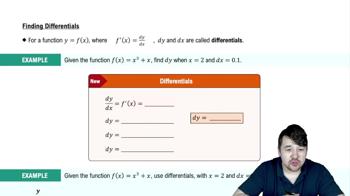 05:53
05:53Differentials Consider the following functions and express the relationship between a small change in x and the corresponding change in y in the form dy = f'(x)dx.
f(x) = sin⁻¹ x
Snell’s Law Suppose a light source at A is in a medium in which light travels at a speed v₁ and that point B is in a medium in which light travels at a speed v₂ (see figure). Using Fermat’s Principle, which states that light travels along the path that requires the minimum travel time (Exercise 55), show that the path taken between points A and B satisfies (sinΘ₁/v₁ = (sin Θ₂) /v₂ . <IMAGE>
Evaluate the following limits. Use l’Hôpital’s Rule when it is convenient and applicable.
lim_x→ 1 (x² + 2x) / (x +3)
17–83. Limits Evaluate the following limits. Use l’Hôpital’s Rule when it is convenient and applicable.
lim_x→ 0 (eˣ - sin x - 1) / (x⁴ + 8x³ + 12x²)
Differentials Consider the following functions and express the relationship between a small change in x and the corresponding change in y in the form dy = f'(x)dx.
f(x) = tan x
Second Derivative Test Locate the critical points of the following functions. Then use the Second Derivative Test to determine (if possible) whether they correspond to local maxima or local minima.
f(x) = eˣ(x - 2)²