Ch. 4 - Applications of the Derivative
Briggs - Calculus: Early Transcendentals 3rd Edition
Briggs3rd EditionCalculus: Early TranscendentalsISBN: 9780136847243Not the one you use?Change textbook
Chapter 4, Problem 4.9.103

A car starting at rest accelerates at 16 ft/s² for 5 seconds on a straight road. How far does it travel during this time?

Verified step by step guidance
1
Step 1: Identify the given values in the problem. The car starts at rest, so the initial velocity (v₀) is 0 ft/s. The acceleration (a) is 16 ft/s², and the time (t) is 5 seconds.
Step 2: Recall the formula for the distance traveled under constant acceleration: s = v0t + 1 2 at² . Since the initial velocity (v₀) is 0, the formula simplifies to s = 1 2 at² .
Step 3: Substitute the given values into the simplified formula. Replace a with 16 ft/s² and t with 5 seconds.
Step 4: Perform the squaring operation on the time value. Compute t² , which is 5² .
Step 5: Multiply the acceleration value by the squared time, then divide by 2 to find the total distance traveled. The result will give the distance in feet.

Verified video answer for a similar problem:

This video solution was recommended by our tutors as helpful for the problem above.
Video duration:
2m
Was this helpful?

Key Concepts

Here are the essential concepts you must grasp in order to answer the question correctly.

Kinematics

Kinematics is the branch of mechanics that describes the motion of objects without considering the forces that cause the motion. It involves concepts such as displacement, velocity, and acceleration. In this problem, kinematics helps us understand how the car's acceleration affects its distance traveled over time.
Recommended video:
10:17
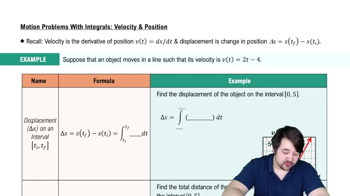
Using The Velocity Function

Acceleration

Acceleration is the rate of change of velocity of an object with respect to time. It is a vector quantity, meaning it has both magnitude and direction. In this scenario, the car accelerates at 16 ft/s², indicating that its velocity increases by 16 feet per second every second, which is crucial for calculating the distance traveled.
Recommended video:
06:15
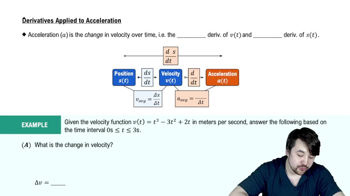
Derivatives Applied To Acceleration

Distance Formula

The distance traveled by an object under constant acceleration can be calculated using the formula: distance = initial velocity × time + 0.5 × acceleration × time². Since the car starts from rest, the initial velocity is zero, simplifying the calculation. This formula allows us to determine how far the car travels during the 5 seconds of acceleration.
Recommended video:
Guided course
5:59
Recursive Formulas
Related Practice
Textbook Question

17–83. Limits Evaluate the following limits. Use l’Hôpital’s Rule when it is convenient and applicable.


lim_x→ 0 (sin² 3x) / x²

268
views

Textbook Question

Increasing and decreasing functions. Find the intervals on which f is increasing and the intervals on which it is decreasing.


f(x) = (x - 1)²

269
views
Textbook Question

Sketch the graph of a continuous function ƒ on [0, 4] satisfying the given properties.


ƒ' (x) and ƒ'3 are undefined; ƒ'(2) = 0; has a local maximum at x= 1; ƒ has local minimum at x = 2; and ƒ has an absolute maximum at x= 3; and ƒ has an absolute minimum at x = 4 .

219
views
Textbook Question

{Use of Tech} A pursuit curve A man stands 1 mi east of a crossroads. At noon, a dog starts walking north from the crossroads at 1 mi/hr (see figure). At the same instant, the man starts walking and at all times walks directly toward the dog at s > 1 mi/hr . The path in the xy-plane followed by the man as he pursues the dog is given by the function y = ƒ(x) = s/2 ((x(ˢ⁺¹)/ˢ) /(s+1) - (x(ˢ⁺¹)/ˢ / s-1)) + s/ s² - 1


Select various values of s > 1 and graph this pursuit curve. Comment on the changes in the curve as s increases. <IMAGE>


225
views
Textbook Question

Second Derivative Test Locate the critical points of the following functions. Then use the Second Derivative Test to determine (if possible) whether they correspond to local maxima or local minima.


f(x) = 2x² ln x - 11x²

210
views
Textbook Question

Increasing and decreasing functions. Find the intervals on which f is increasing and the intervals on which it is decreasing.


f(x) = tan⁻¹ (x/(x²+2))

221
views