
Ch. 4 - Applications of the Derivative
Briggs - Calculus: Early Transcendentals 3rd Edition
Briggs3rd EditionCalculus: Early TranscendentalsISBN: 9780136847243Not the one you use?Change textbook
Chapter 4, Problem 4.1.77a

Explain why or why not Determine whether the following statements are true and give an explanation or counterexample.


a. The function f(x) = √x has a local maximum on the interval [0,∞).

Verified step by step guidance
1
To determine if the function f(x) = √x has a local maximum on the interval [0, ∞), we first need to understand what a local maximum is. A function f(x) has a local maximum at a point x = c if there exists an interval (a, b) containing c such that f(c) ≥ f(x) for all x in (a, b).
Next, consider the behavior of the function f(x) = √x. As x increases from 0 to ∞, the value of √x also increases. This suggests that the function is monotonically increasing on the interval [0, ∞).
To further analyze, we can take the derivative of f(x) to examine its critical points. The derivative f'(x) = (1/2)x^(-1/2) is positive for all x > 0, indicating that the function is increasing on its entire domain.
Since the function is increasing and has no points where the derivative is zero or undefined (other than at x = 0, where the derivative is undefined but the function is still increasing), there are no local maxima on the interval [0, ∞).
Therefore, the statement that the function f(x) = √x has a local maximum on the interval [0, ∞) is false. The function does not have a local maximum because it continuously increases without reaching a peak.

Verified video answer for a similar problem:

This video solution was recommended by our tutors as helpful for the problem above.
Video duration:
2m
Was this helpful?

Key Concepts

Here are the essential concepts you must grasp in order to answer the question correctly.

Local Maximum

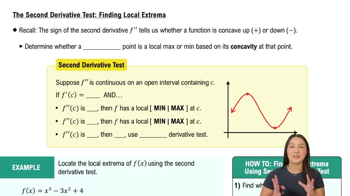
A local maximum of a function occurs at a point where the function's value is greater than the values of the function at nearby points. To determine if a function has a local maximum, one typically examines the first derivative to find critical points and the second derivative to assess concavity. In the context of the given function, understanding local maxima is essential to evaluate its behavior over the specified interval.
Recommended video:
06:02
The Second Derivative Test: Finding Local Extrema

Derivative and Critical Points

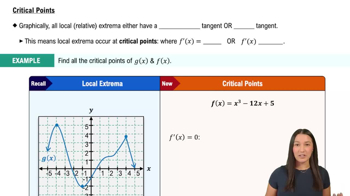
The derivative of a function provides information about its rate of change and is used to find critical points, where the derivative is zero or undefined. These points are potential candidates for local maxima or minima. For the function f(x) = √x, calculating the derivative helps identify whether there are any points in the interval [0, ∞) where the function reaches a local maximum.
Recommended video:
04:50
Critical Points

Behavior of the Function on the Interval

Analyzing the behavior of the function on the specified interval is crucial for determining the presence of local maxima. For f(x) = √x, one must consider how the function behaves as x approaches 0 and as x increases towards infinity. Understanding the overall trend of the function helps in concluding whether it can attain a local maximum within the given interval.
Recommended video:
5:46
Graphs of Exponential Functions
Related Practice
Textbook Question

{Use of Tech} A damped oscillator The displacement of an object as it bounces vertically up and down on a spring is given by y(t) = 2.5e⁻ᵗ cos 2t, where the initial displacement is y(0) = 2.5 and y = 0 corresponds to the rest position (see figure). <IMAGE>

a. Find the time at which the object first passes the rest position, y = 0. 

247
views
Textbook Question

Do dogs know calculus? A mathematician stands on a beach with his dog at point A. He throws a tennis ball so that it hits the water at point B. The dog, wanting to get to the tennis ball as quickly as possible, runs along the straight beach line to point D and then swims from point D to point B to retrieve his ball. Assume C is the point on the edge of the beach closest to the tennis ball (see figure). <IMAGE>


a. Assume the dog runs at speed r and swims at speed s, where r > s and both are measured in meters per second. Also assume the lengths of BC, CD, and AC are x, y, and z, respectively. Find a function T(y) representing the total time it takes for the dog to get to the ball. 

346
views
Textbook Question

{Use of Tech} Elliptic curves The equation y² = x³ - ax + 3, where a is a parameter, defines a well-known family of elliptic curves.


a. Plot a graph of the curve when a = 3.

997
views
Textbook Question

Two poles of heights m and n are separated by a horizontal distance d. A rope is stretched from the top of one pole to the ground and then to the top of the other pole. Show that the configuration that requires the least amount of rope occurs when Θ₁ = Θ₂ (see figure). <IMAGE>

210
views
Textbook Question

{Use of Tech} Every second counts You must get from a point P on the straight shore of a lake to a stranded swimmer who is 50 from a point Q on the shore that is 50 m from you (see figure). Assuming that you can swim at a speed of 2 m/s and run at a speed of 4 m/s, the goal of this exercise is to determine the point along the shore, x meters from Q, where you should stop running and start swimming to reach the swimmer in the minimum time. <IMAGE>


a. Find the function T that gives the travel time as a function of x, where 0 ≤ x ≤ 50.

202
views
Textbook Question

{Use of Tech} Fixed points of quadratics and quartics Let f(x) = ax(1 -x), where a is a real number and 0 ≤ a ≤ 1. Recall that the fixed point of a function is a value of x such that f(x) = x (Exercises 48–51). 


a. Without using a calculator, find the values of a, with 0 ≤ a ≤ 4, such that f  has a fixed point. Give the fixed point in terms of a. 

247
views