
Textbook Question
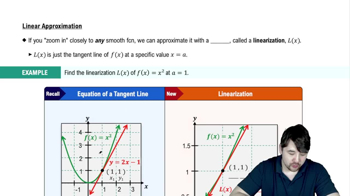
Use linear approximation to estimate f (3.85) given that f(4) = 3 and f'(4) = 2.
265
views

 Verified step by step guidance
 05:53
05:53
 07:17
07:17 04:16
04:16Use linear approximation to estimate f (3.85) given that f(4) = 3 and f'(4) = 2.
Graphing functions Use the guidelines of this section to make a complete graph of f.
f(x) = x³ - 6x² - 135x
17–83. Limits Evaluate the following limits. Use l’Hôpital’s Rule when it is convenient and applicable.
lim_x→ 1 (4 tan⁻¹ x- π) / (x-1)
Graphing functions Use the guidelines of this section to make a complete graph of f.
f(x) = ln (x² + 1)
23–68. Indefinite integrals Determine the following indefinite integrals. Check your work by differentiation.
∫ (1/2y)dy
{Use of Tech} Growth rate of spotted owlets The rate of growth (in g/week) of the body mass of Indian spotted owlets is modeled by the function r(t) = 10,147.9e⁻²·²ᵗ/(37.98e⁻²·² + 1), where t is the age (in weeks) of the owlets. What value of t > 0 maximizes r? What is the physical meaning of the maximum value?