Ch. 5 - Integration
Briggs - Calculus: Early Transcendentals 3rd Edition
Briggs3rd EditionCalculus: Early TranscendentalsISBN: 9780136847243Not the one you use?Change textbook
Chapter 5, Problem 5.1.19

Approximating displacement The velocity of an object is given by the following functions on a specified interval. Approximate the displacement of the object on this interval by subdividing the interval into n subintervals. Use the left endpoint of each subinterval to compute the height of the rectangles.
v = [1 / (2t + 1)] (m/s), for 0 ≤ t ≤ 8 ; n = 4

Verified step by step guidance
1
Step 1: Understand the problem. The goal is to approximate the displacement of the object over the interval [0, 8] using the velocity function v = 1 / (2t + 1). The interval is subdivided into n = 4 subintervals, and the left endpoint of each subinterval is used to compute the height of the rectangles.
Step 2: Determine the width of each subinterval. The interval [0, 8] is divided into n = 4 subintervals, so the width of each subinterval (Δt) is calculated as Δt = (8 - 0) / 4 = 2.
Step 3: Identify the left endpoints of each subinterval. Since the interval is divided into 4 subintervals of width 2, the left endpoints are t = 0, t = 2, t = 4, and t = 6.
Step 4: Compute the height of each rectangle using the velocity function at the left endpoints. For each left endpoint t_i, calculate v(t_i) = 1 / (2t_i + 1). Specifically, compute v(0), v(2), v(4), and v(6).
Step 5: Approximate the displacement by summing the areas of the rectangles. The area of each rectangle is given by height × width = v(t_i) × Δt. Add these areas together to approximate the total displacement: Displacement ≈ Δt × [v(0) + v(2) + v(4) + v(6)].

Verified video answer for a similar problem:

This video solution was recommended by our tutors as helpful for the problem above.
Video duration:
3m
Was this helpful?

Key Concepts

Here are the essential concepts you must grasp in order to answer the question correctly.

Velocity and Displacement

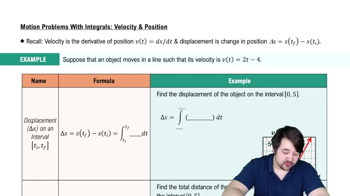
Velocity is the rate of change of displacement with respect to time, indicating how fast an object moves in a specific direction. Displacement, on the other hand, is the total distance moved in a particular direction over a given time interval. Understanding the relationship between velocity and displacement is crucial for approximating the total displacement of an object over a specified time period.
Recommended video:
10:17
Using The Velocity Function

Riemann Sums

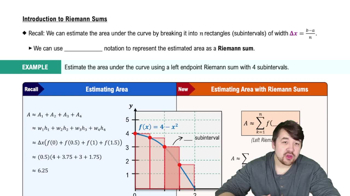
Riemann sums are a method for approximating the integral of a function, which in this context helps estimate the total displacement. By dividing the interval into smaller subintervals and using the left endpoint of each subinterval to determine the height of rectangles, we can sum the areas of these rectangles to approximate the integral. This technique is foundational in calculus for understanding how to calculate areas under curves.
Recommended video:
06:11
Introduction to Riemann Sums

Subintervals and Partitioning

Partitioning an interval into subintervals involves dividing the total time interval into smaller segments, which allows for more accurate approximations of the function's behavior. In this case, with n = 4, the interval from 0 to 8 is divided into four equal parts. This subdivision is essential for applying Riemann sums effectively, as it determines how the function is sampled and influences the accuracy of the displacement approximation.
Recommended video:
06:11
Introduction to Riemann Sums
Related Practice
Textbook Question

Symmetry in integrals Use symmetry to evaluate the following integrals.

∫²₋₂ [(x³ ― 4x) / (x² + 1)] dx 

134
views

Textbook Question

Definite integrals Use a change of variables or Table 5.6 to evaluate the following definite integrals.                                                                                                                         


 ∫₀^π/⁴ eˢᶦⁿ² ˣ sin 2𝓍 d𝓍

104
views
Textbook Question

{Use of Tech} Areas of regions Find the area of the region 𝑅 bounded by the graph of ƒ and the 𝓍-axis on the given interval. Graph ƒ and show the region 𝑅.                                              


 ƒ(𝓍) = 2 ― |𝓍| on [ ― 2 , 4]

74
views
Textbook Question

Limits of sums Use the definition of the definite integral to evaluate the following definite integrals. Use right Riemann sums and Theorem 5.1.


∫₃⁷ (4𝓍 + 6) d𝓍

104
views
Textbook Question

Identifying Riemann sums Fill in the blanks with an interval and a value of n.


4

∑ ƒ (1.5 + k) • 1 is a midpoint Riemann sum for f on the interval [ ___ , ___ ]

k = 1

with n = ________ .

63
views
Textbook Question

Identifying definite integrals as limits of sums Consider the following limits of Riemann sums for a function ƒ on [a,b]. Identify ƒ and express the limit as a definite integral.                                

          n                                                                                                                                                                              

    lim   ∑   𝓍*ₖ (ln 𝓍*ₖ) ∆𝓍ₖ on [1,2]                                                                                                                                                                            

  ∆ → 0   k=1                                                                                                                                                                                                                      

77
views