Ch. 5 - Integration
Briggs - Calculus: Early Transcendentals 3rd Edition
Briggs3rd EditionCalculus: Early TranscendentalsISBN: 9780136847243Not the one you use?Change textbook
Chapter 5, Problem 5.3.14a

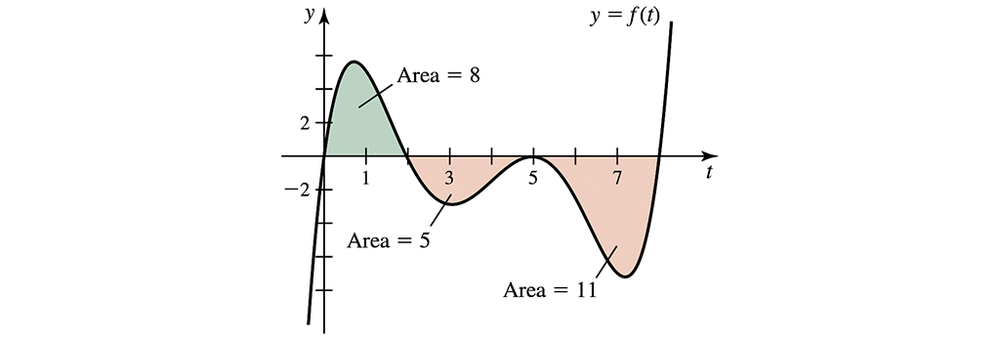
Area functions The graph of ƒ is shown in the figure. Let A(x) = ∫₀ˣ ƒ(t) dt and F(x) = ∫₂ˣ ƒ(t) dt be two area functions for ƒ. Evaluate the following area functions.
(a) A(2)

Verified step by step guidance
1
Step 1: Understand the problem. We are tasked with evaluating A(2), where A(x) = ∫₀ˣ ƒ(t) dt. This represents the area under the curve of ƒ(t) from t = 0 to t = x.
Step 2: Analyze the graph. The graph shows the function ƒ(t) and the areas of specific regions. From t = 0 to t = 1, the area is shaded green and labeled as 'Area = 8'. This area is above the t-axis, so it contributes positively to the integral.
Step 3: From t = 1 to t = 2, the graph dips below the t-axis, and the area is shaded green and labeled as 'Area = 5'. Since this region is below the t-axis, it contributes negatively to the integral.
Step 4: To compute A(2), sum the contributions of the areas from t = 0 to t = 2. Specifically, add the positive area from t = 0 to t = 1 and subtract the negative area from t = 1 to t = 2.
Step 5: Write the expression for A(2): A(2) = (Area from t = 0 to t = 1) - (Area from t = 1 to t = 2). Substitute the values from the graph: A(2) = 8 - 5.

Verified video answer for a similar problem:

This video solution was recommended by our tutors as helpful for the problem above.
Video duration:
1m
Was this helpful?

Key Concepts

Here are the essential concepts you must grasp in order to answer the question correctly.

Definite Integral

A definite integral represents the signed area under a curve between two points on the x-axis. It is calculated using the integral symbol and limits of integration, providing a numerical value that corresponds to the net area, accounting for areas above and below the x-axis.
Recommended video:
05:43
Definition of the Definite Integral

Area Function

An area function, such as A(x) = ∫₀ˣ ƒ(t) dt, defines the accumulated area under the curve of a function ƒ from a starting point to a variable endpoint x. This function helps in understanding how the area changes as x varies, and it is crucial for evaluating specific area values at given points.
Recommended video:
05:06
Finding Area When Bounds Are Not Given

Fundamental Theorem of Calculus

The Fundamental Theorem of Calculus links differentiation and integration, stating that if F is an antiderivative of f on an interval, then the definite integral of f from a to b can be computed as F(b) - F(a). This theorem is essential for evaluating area functions and understanding their properties.
Recommended video:
06:11
Fundamental Theorem of Calculus Part 1
Related Practice
Textbook Question

Using properties of integrals Use the value of the first integral I to evaluate the two given integrals. 

I = ∫₀¹ (𝓍³ ― 2𝓍) d𝓍 = ―3/4

(a) ∫₀¹ (4𝓍―2𝓍³) d𝓍

110
views

Textbook Question

Area functions for linear functions Consider the following functions ƒ and real numbers a (see figure).

(a) Find and graph the area function A (𝓍) = ∫ₐˣ ƒ(t) dt .

ƒ(t) = 2t + 5 , a = 0

105
views
Textbook Question

Use Table 5.6 to evaluate the following indefinite integrals.                                                                                                               


 (a) ∫ e¹⁰ˣ d𝓍

78
views
Textbook Question

Area functions for the same linear function Let ƒ(t) = 2t ― 2 and consider the two area functions A (𝓍) = ∫₁ˣ ƒ(t) dt and F(𝓍) = ∫₄ˣ ƒ(t) dt .

(a) Evaluate A (2) and A (3). Then use geometry to find an expression for A (𝓍) , for 𝓍 ≥ 1 .

70
views
Textbook Question

Properties of integrals Use only the fact that ∫₀⁴ 3𝓍 (4 ―𝓍) d𝓍 = 32, and the definitions and properties of integrals, to evaluate the following integrals, if possible.

(a) ∫₄⁰ 3𝓍(4 ― 𝓍) d(𝓍)

61
views
Textbook Question

Substitutions Suppose ƒ is an even function with ∫₀⁸ ƒ(𝓍) d𝓍 = 9 . Evaluate each integral.                                                                                                       

(a) ∫¹₋₁ 𝓍ƒ(𝓍²) d𝓍

44
views