Ch. 5 - Integration
Briggs - Calculus: Early Transcendentals 3rd Edition
Briggs3rd EditionCalculus: Early TranscendentalsISBN: 9780136847243Not the one you use?Change textbook
Chapter 5, Problem 5.5.102

Average distance on a triangle Consider the right triangle with vertices (0,0) ,(0,b) , and (a,0) , where a > 0 and b > 0. Show that the average vertical distance from points on the 𝓍-axis to the hypotenuse is b/2 , for all a > 0 .

Verified step by step guidance
1
First, identify the hypotenuse line connecting the points (0, b) and (a, 0). Find its equation by calculating the slope and using point-slope form. The slope \( m \) is given by \( m = \frac{0 - b}{a - 0} = -\frac{b}{a} \). Using point (0, b), the line equation is \( y = -\frac{b}{a} x + b \).
Next, consider a point on the x-axis, which has coordinates \( (x, 0) \) where \( x \) ranges from 0 to \( a \). We want to find the vertical distance from this point to the hypotenuse. Since the point is on the x-axis, the vertical distance to the hypotenuse is simply the y-value of the hypotenuse at \( x \), which is \( y = -\frac{b}{a} x + b \).
To find the average vertical distance from all points on the x-axis between 0 and \( a \) to the hypotenuse, set up the integral of the vertical distance function over the interval \( [0, a] \) and divide by the length of the interval \( a \). This gives the average distance \( D_{avg} = \frac{1}{a} \int_0^a \left(-\frac{b}{a} x + b\right) dx \).
Evaluate the integral \( \int_0^a \left(-\frac{b}{a} x + b\right) dx \) by integrating term-by-term: \( \int_0^a -\frac{b}{a} x \, dx + \int_0^a b \, dx \). Compute each integral separately.
After integrating, simplify the expression and divide by \( a \) to find the average vertical distance. You should find that the average distance simplifies to \( \frac{b}{2} \), which is independent of \( a \), as required.

Verified video answer for a similar problem:

This video solution was recommended by our tutors as helpful for the problem above.
Video duration:
4m
Was this helpful?

Key Concepts

Here are the essential concepts you must grasp in order to answer the question correctly.

Equation of a Line (Hypotenuse)

To analyze distances to the hypotenuse, first find its equation. The hypotenuse connects points (0,b) and (a,0), so its slope is -b/a. Using point-slope form, the line equation is y = b - (b/a)x, which describes the hypotenuse for all x between 0 and a.
Recommended video:
05:14
Equations of Tangent Lines

Vertical Distance from a Point to a Line

The vertical distance from a point on the x-axis (x,0) to the hypotenuse is the difference in y-values since the point lies on y=0. This distance equals the y-coordinate of the hypotenuse at x, which is y = b - (b/a)x. Understanding this helps set up the integral for the average distance.
Recommended video:
06:17
Convert Points from Polar to Rectangular

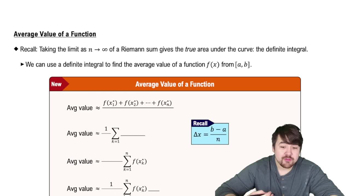
Average Value of a Function over an Interval

The average vertical distance is the average value of the function y = b - (b/a)x over [0,a]. This is found by integrating the function over the interval and dividing by the interval length a. Calculating this integral shows the average distance equals b/2, independent of a.
Recommended video:
06:37
Average Value of a Function
Related Practice
Textbook Question

Evaluate


lim [ βˆ«β‚‚Λ£ √(tΒ² + t + 3dt) ] / (𝓍² ―4)

𝓍→2

45
views
Textbook Question

Definite integrals Evaluate the following integrals using the Fundamental Theorem of Calculus


βˆ«β‚Β² 3/t dt

95
views
Textbook Question

Definite integrals Use geometry (not Riemann sums) to evaluate the following definite integrals. Sketch a graph of the integrand, show the region in question, and interpret your result.


 βˆ«β‚€β΄ Ζ’(𝓍) d𝓍, where Ζ’(𝓍) = {5      if π“ ≀ 2                                                                                                                                                                                     

                      3𝓍 ― 1  if π“ > 2

147
views
Textbook Question

Approximating displacement The velocity of an object is given by the following functions on a specified interval. Approximate the displacement of the object on this interval by subdividing the interval into n subintervals. Use the left endpoint of each subinterval to compute the height of the rectangles.

v = 2t + 1(m/s), for 0 ≀ t ≀ 8 ; n = 2

84
views
Textbook Question

Definite integrals from graphs The figure shows the areas of regions bounded by the graph of Ζ’ and the 𝓍-axis. Evaluate the following integrals.


βˆ«β‚€αΆœ |Ζ’(𝓍)| d𝓍

143
views
Textbook Question

Derivatives of integrals Simplify the following expressions.


d/d𝓍 βˆ«β‚€Λ£ (√1 + tΒ²) dt (Hint: βˆ«Λ£β‚‹β‚“ (√1 + tΒ²) dt = βˆ«β°β‚‹β‚“ (√1 + tΒ²) dt + βˆ«Λ£β‚‹β‚“ (√1 + tΒ²) dt ) .

60
views