Ch. 5 - Integration
Briggs - Calculus: Early Transcendentals 3rd Edition
Briggs3rd EditionCalculus: Early TranscendentalsISBN: 9780136847243Not the one you use?Change textbook
Chapter 5, Problem 5.4.56

Average value of the derivative Suppose ƒ ' is a continuous function for all real numbers. Show that the average value of the derivative on an interval [a, b] is ƒ⁻' = (ƒ(b) ―ƒ(a))/ (b―a) . Interpret this result in terms of secant lines.

Verified step by step guidance
1
Step 1: Recall the Mean Value Theorem (MVT) for derivatives, which states that if a function ƒ is continuous on [a, b] and differentiable on (a, b), then there exists a point c in (a, b) such that ƒ'(c) = (ƒ(b) - ƒ(a)) / (b - a). This theorem provides the foundation for the average value of the derivative.
Step 2: Define the average value of the derivative over the interval [a, b]. The average value of ƒ'(x) on [a, b] is given by the integral formula: (1 / (b - a)) ∫[a, b] ƒ'(x) dx. This formula calculates the mean rate of change of the function over the interval.
Step 3: Apply the Fundamental Theorem of Calculus to the integral ∫[a, b] ƒ'(x) dx. According to this theorem, the integral of the derivative of a function over an interval is equal to the net change in the function over that interval: ∫[a, b] ƒ'(x) dx = ƒ(b) - ƒ(a).
Step 4: Substitute the result from Step 3 into the average value formula. Replace ∫[a, b] ƒ'(x) dx with ƒ(b) - ƒ(a) to get: (1 / (b - a)) ∫[a, b] ƒ'(x) dx = (ƒ(b) - ƒ(a)) / (b - a). This shows that the average value of the derivative is equal to the slope of the secant line connecting the points (a, ƒ(a)) and (b, ƒ(b)).
Step 5: Interpret the result in terms of secant lines. The average value of the derivative on [a, b] represents the slope of the secant line between the endpoints of the interval. This means that the average rate of change of the function over the interval is equivalent to the slope of the straight line connecting the points (a, ƒ(a)) and (b, ƒ(b)) on the graph of ƒ.

Verified video answer for a similar problem:

This video solution was recommended by our tutors as helpful for the problem above.
Video duration:
2m
Was this helpful?

Key Concepts

Here are the essential concepts you must grasp in order to answer the question correctly.

Average Value of a Function

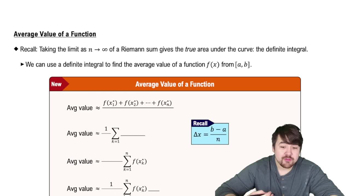
The average value of a function over an interval [a, b] is defined as the integral of the function over that interval divided by the length of the interval. For a continuous function f, this is expressed mathematically as (1/(b-a)) * ∫[a to b] f(x) dx. This concept is crucial for understanding how the behavior of a function can be summarized over a specific range.
Recommended video:
06:37
Average Value of a Function

Derivative and Its Interpretation

The derivative of a function at a point measures the rate of change of the function with respect to its variable. It is represented as f'(x) and can be interpreted as the slope of the tangent line to the curve at that point. Understanding derivatives is essential for analyzing how functions behave locally and for connecting to the concept of average rates of change over intervals.
Recommended video:
05:44
Derivatives

Secant Lines

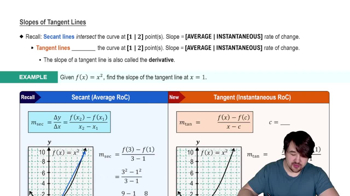
A secant line is a straight line that connects two points on a curve, representing the average rate of change of the function between those two points. The slope of the secant line between points (a, f(a)) and (b, f(b)) is given by (f(b) - f(a)) / (b - a). This concept helps visualize the average value of the derivative, as the slope of the secant line approximates the derivative as the interval narrows.
Recommended video:
05:13
Slopes of Tangent Lines
Related Practice
Textbook Question

Indefinite integrals Use a change of variables or Table 5.6 to evaluate the following indefinite integrals. Check your work by differentiating.                                                                                  


 ∫ sec 4w tan 4w dw

55
views

Textbook Question

Symmetry in integrals Use symmetry to evaluate the following integrals.

∫²₋₂ [(x³ ― 4x) / (x² + 1)] dx 

134
views
Textbook Question

Definite integrals Use a change of variables or Table 5.6 to evaluate the following definite integrals.                                                                                                                         


 ∫₀^π/⁴ eˢᶦⁿ² ˣ sin 2𝓍 d𝓍

104
views
Textbook Question

Definite integrals from graphs The figure shows the areas of regions bounded by the graph of ƒ and the 𝓍-axis. Evaluate the following integrals.


∫₀ᵃ ƒ(𝓍) d𝓍

57
views
Textbook Question

General results Evaluate the following integrals in which the function ƒ is unspecified. Note that ƒ⁽ᵖ⁾ is the pth derivative of ƒ and ƒᵖ is the pth power of ƒ. Assume ƒ and its derivatives are continuous for all real numbers. 

∫ (5 ƒ³ (𝓍) + 7ƒ² (𝓍) + ƒ (𝓍 )) ƒ'(𝓍) d𝓍

85
views
Textbook Question

Indefinite integrals Use a change of variables or Table 5.6 to evaluate the following indefinite integrals. Check your work by differentiating.                                                                                  


 ∫ (sin⁵ 𝓍 + 3 sin³ 𝓍― sin 𝓍) cos 𝓍 d𝓍

74
views