Ch. 5 - Integration
Briggs - Calculus: Early Transcendentals 3rd Edition
Briggs3rd EditionCalculus: Early TranscendentalsISBN: 9780136847243Not the one you use?Change textbook
Chapter 5, Problem 5.4.58a

Bounds on an integral Suppose ƒ is continuous on [a, b] with ƒ''(𝓍) > 0 on the interval. It can be shown that (b―a) ƒ [(a + b) /2] ≤ ∫ₐᵇ ƒ(𝓍) d𝓍 ≤ (b―a) [ (ƒ(a) + ƒ(b)) /2]                                                         
                                                                                                                                                                               
(a) Assuming ƒ is nonnegative on [a, b], draw a figure to illustrate the geometric meaning of these inequalities. Discuss your conclusions. b. 

Verified step by step guidance
1
Step 1: Understand the given inequality. Since \( f''(x) > 0 \) on \([a, b]\), the function \( f \) is convex on this interval. The inequality states that: \[ (b - a) f\left(\frac{a + b}{2}\right) \leq \int_a^b f(x) \, dx \leq (b - a) \frac{f(a) + f(b)}{2} \] This means the integral of \( f \) over \([a, b]\) is bounded below by the area of a rectangle with height \( f \) at the midpoint, and above by the area of a trapezoid formed by the values at the endpoints.
Step 2: Sketch the graph of \( f \) on the interval \([a, b]\). Since \( f \) is convex, the curve lies below the line segment connecting \( (a, f(a)) \) and \( (b, f(b)) \). Mark the points \( (a, f(a)) \), \( (b, f(b)) \), and the midpoint \( \left(\frac{a+b}{2}, f\left(\frac{a+b}{2}\right)\right) \).
Step 3: Illustrate the lower bound: draw a rectangle with base \( (b - a) \) and height \( f\left(\frac{a+b}{2}\right) \). This rectangle represents the quantity \( (b - a) f\left(\frac{a+b}{2}\right) \), which is less than or equal to the integral.
Step 4: Illustrate the upper bound: draw the trapezoid formed by the points \( (a, 0) \), \( (a, f(a)) \), \( (b, f(b)) \), and \( (b, 0) \). The area of this trapezoid is \( (b - a) \frac{f(a) + f(b)}{2} \), which is greater than or equal to the integral.
Step 5: Discuss conclusions: Since \( f \) is convex and nonnegative, the integral (area under the curve) lies between the area of the midpoint rectangle and the trapezoid formed by the endpoints. This reflects how convexity controls the shape of \( f \) and provides useful bounds for the integral.

Verified video answer for a similar problem:

This video solution was recommended by our tutors as helpful for the problem above.
Video duration:
2m
Was this helpful?

Key Concepts

Here are the essential concepts you must grasp in order to answer the question correctly.

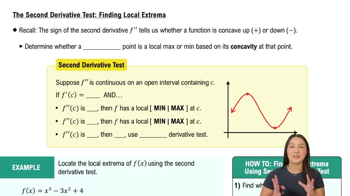
Convexity and the Second Derivative Test

A function ƒ is convex on [a, b] if its second derivative ƒ''(x) is positive throughout the interval. This means the graph of ƒ lies below any chord connecting two points on the curve. Convexity ensures certain inequalities hold for integrals and averages of the function values.
Recommended video:
06:02
The Second Derivative Test: Finding Local Extrema

Integral Bounds and the Midpoint and Trapezoidal Approximations

The integral of ƒ over [a, b] can be bounded using the midpoint rule (evaluating ƒ at (a+b)/2) and the trapezoidal rule (averaging ƒ(a) and ƒ(b)). For convex functions, the midpoint approximation underestimates the integral, while the trapezoidal approximation overestimates it, providing useful bounds.
Recommended video:
06:18
Integration by Parts for Definite Integrals

Geometric Interpretation of Integral Inequalities

The inequalities relate areas under the curve to areas of simple geometric shapes: a rectangle at the midpoint and a trapezoid formed by endpoints. For a convex function, the curve lies below the trapezoid and above the midpoint rectangle, visually explaining why the integral is bounded between these two approximations.
Recommended video:
Guided course
04:18
Geometric Sequences - Recursive Formula
Related Practice
Textbook Question

{Use of Tech} Midpoint Riemann sums with a calculator Consider the following definite integrals.

(a) Write the midpoint Riemann sum in sigma notation for an arbitrary value of n.


∫₀⁴ (4𝓍― 𝓍²) d𝓍

119
views

Textbook Question

Area functions for linear functions Consider the following functions ƒ and real numbers a (see figure).                                                                                           


 (a) Find and graph the area function A (𝓍) = ∫ₐˣ ƒ(t) dt .                                                                                                                               


 <IMAGE>                                                                                                                                                                                                           


 ƒ(t) = 4t + 2 , a = 0

88
views
Textbook Question

Working with area functions Consider the function ƒ and its graph.

(a) Estimate the zeros of the area function A(𝓍) = ∫₀ˣ ƒ(t) dt , for 0 ≤ 𝓍 ≤ 10 .


36
views
Textbook Question

{Use of Tech} Midpoint Riemann sums with a calculator Consider the following definite integrals.

(a) Write the midpoint Riemann sum in sigma notation for an arbitrary value of n.


∫₁⁴ 2√𝓍 d𝓍

81
views
Textbook Question

Sigma notation Express the following sums using sigma notation. (Answers are not unique.)

(a) 1 + 2 + 3 + 4 + 5

110
views
Textbook Question

Using properties of integrals Use the value of the first integral I to evaluate the two given integrals. 

I = ∫₀^π/2 (cos θ ― 2 sin θ) dθ = ―1

(a) ∫₀^π/2 (2 sin θ ― cos θ) dθ

82
views