Ch. 5 - Integration
Briggs - Calculus: Early Transcendentals 3rd Edition
Briggs3rd EditionCalculus: Early TranscendentalsISBN: 9780136847243Not the one you use?Change textbook
Chapter 5, Problem 5.R.39

Evaluating integrals Evaluate the following integrals.


∫₋₂² (3𝓍⁴―2𝓍 + 1) d𝓍

Verified step by step guidance
1
Step 1: Recognize that the integral ∫₋₂² (3𝓍⁴―2𝓍 + 1) d𝓍 is a definite integral, meaning we will evaluate the antiderivative of the function and then compute the difference between its values at the upper and lower limits.
Step 2: Break the integral into separate terms for easier computation: ∫₋₂² (3𝓍⁴) d𝓍 - ∫₋₂² (2𝓍) d𝓍 + ∫₋₂² (1) d𝓍.
Step 3: Compute the antiderivative of each term: For 3𝓍⁴, the antiderivative is (3/5)𝓍⁵; for -2𝓍, the antiderivative is -𝓍²; and for 1, the antiderivative is 𝓍.
Step 4: Apply the Fundamental Theorem of Calculus: Substitute the upper limit (𝓍 = 2) and lower limit (𝓍 = -2) into the antiderivative of each term, and compute the difference between the values at these limits.
Step 5: Combine the results from each term to find the total value of the definite integral. This involves adding the contributions from (3/5)𝓍⁵, -𝓍², and 𝓍 after evaluating them at the limits.

Verified video answer for a similar problem:

This video solution was recommended by our tutors as helpful for the problem above.
Video duration:
4m
Was this helpful?

Key Concepts

Here are the essential concepts you must grasp in order to answer the question correctly.

Definite Integrals

A definite integral calculates the accumulation of a function's values over a specific interval, represented as ∫[a,b] f(x) dx. The result is a numerical value that represents the area under the curve of the function f(x) from x = a to x = b. Understanding the limits of integration and how they affect the area calculation is crucial for evaluating definite integrals.
Recommended video:
05:43
Definition of the Definite Integral

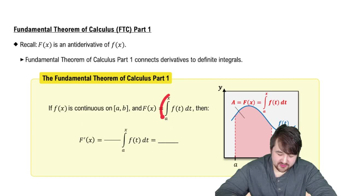
Fundamental Theorem of Calculus

The Fundamental Theorem of Calculus links differentiation and integration, stating that if F is an antiderivative of f on an interval [a, b], then ∫[a,b] f(x) dx = F(b) - F(a). This theorem allows us to evaluate definite integrals by finding the antiderivative of the integrand, simplifying the process of calculating areas under curves.
Recommended video:
06:11
Fundamental Theorem of Calculus Part 1

Polynomial Functions

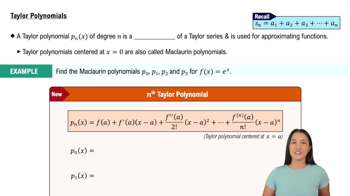
Polynomial functions are expressions of the form f(x) = a_n x^n + a_(n-1) x^(n-1) + ... + a_1 x + a_0, where a_n are coefficients and n is a non-negative integer. In the given integral, the function 3x⁴ - 2x + 1 is a polynomial, and understanding how to integrate polynomial functions is essential, as they can be integrated term by term using the power rule.
Recommended video:
07:00
Taylor Polynomials
Related Practice
Textbook Question

(b) Find the average value of ƒ shown in the figure on the interval [2,6] and then find the point(s) c in (2, 6) guaranteed to exist by the Mean Value Theorem for Integrals. 

47
views

Textbook Question

Geometry of integrals Without evaluating the integrals, explain why the following statement is true for positive integers n:

∫₀¹ 𝓍ⁿd𝓍 + ∫₀¹ ⁿ√(𝓍d𝓍) = 1

70
views
Textbook Question

Area of regions Compute the area of the region bounded by the graph of ƒ and the 𝓍-axis on the given interval. You may find it useful to sketch the region.                                              


 ƒ(𝓍) = 2 sin 𝓍/4 on [0, 2π]

103
views
Textbook Question

Properties of integrals Suppose ∫₁⁴ ƒ(𝓍) d𝓍 = 6 , ∫₁⁴ g(𝓍) d𝓍 = 4 and ∫₃⁴ ƒ(𝓍) d𝓍 = 2 . Evaluate the following integrals or state that there is not enough information.


∫₁³ ƒ(𝓍)/g(𝓍) d𝓍

42
views
Textbook Question

Area by geometry Use geometry to evaluate the following definite integrals, where the graph of ƒ is given in the figure.

(c) ∫₅⁷ ƒ(𝓍) d𝓍

74
views
Textbook Question

Evaluating integrals Evaluate the following integrals.


∫₁ᵉ d𝓍 / [𝓍(1 + ln 𝓍)]

82
views